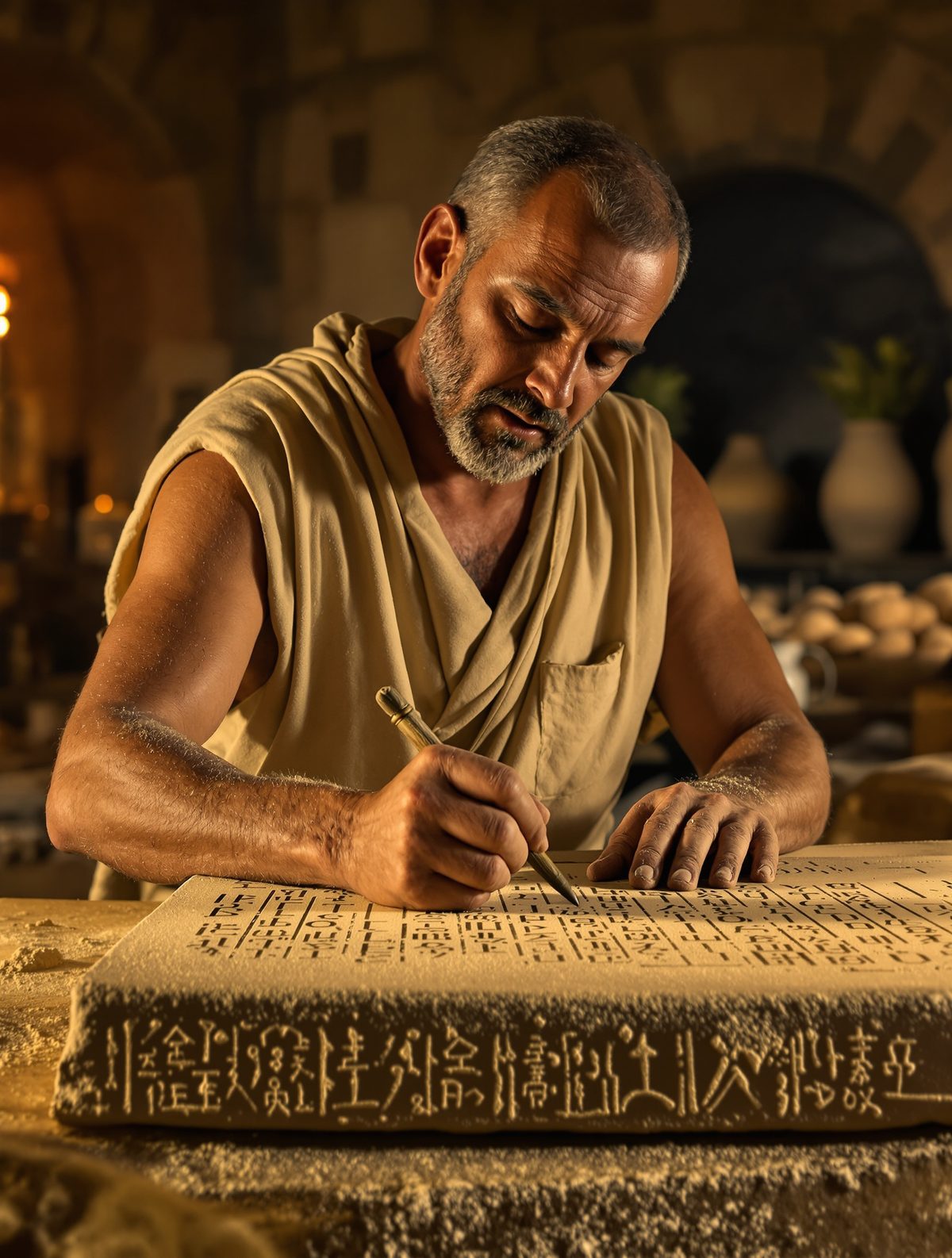
Picture this: it's 456 BC, and you're standing in the sun-baked hills of Sicily. A bald old man sits peacefully in the shade, perhaps composing verses in his head—the same brilliant mind that gave the world some of its greatest tragedies. Suddenly, a shadow passes overhead. An eagle, circling high above with a struggling tortoise clutched in its talons, mistakes the gleaming dome of the man's head for a rocky outcrop. The bird releases its prey. Seconds later, the father of Greek tragedy lies dead, killed by the very absurdity he might have written into one of his comedic moments.
This wasn't just any old man. This was Aeschylus—the towering genius who transformed theater from religious ritual into profound human drama, the veteran warrior who fought at Marathon, and the poet whose words still echo through stages worldwide. And according to ancient sources, this is exactly how one of history's greatest playwrights met his end: felled by a falling turtle, delivered by an eagle who couldn't tell the difference between a bald head and a rock.
The Titan Who Built Theater
To understand just how bizarre Aeschylus's death was, you first need to grasp the magnitude of what he accomplished in life. Born around 525 BC in Eleusis, just outside Athens, Aeschylus didn't just write plays—he invented drama as we know it. Before him, Greek theater consisted mostly of a single actor interacting with a chorus. Aeschylus introduced the revolutionary concept of a second actor, creating the possibility for true dialogue, conflict, and dramatic tension.
This might sound like a small innovation, but it was like inventing the wheel for storytelling. Suddenly, characters could argue, scheme, love, and betray each other right there on stage. The audience could witness the clash of opposing wills, the stuff that makes drama truly dramatic. By the time of his death, Aeschylus had written an estimated 90 plays, winning the prestigious City Dionysia festival an astounding 13 times.
His masterpiece, The Oresteia, remains the only complete Greek tragic trilogy to survive to modern times. This sweeping saga follows the cursed House of Atreus through three generations of bloodshed, culminating in the establishment of justice through democratic courts rather than endless revenge. It's a work of such psychological depth and political sophistication that scholars still debate its meanings today.
But Aeschylus wasn't just a playwright—he was a warrior-poet in the truest sense. He fought at the Battle of Marathon in 490 BC, where outnumbered Greeks miraculously defeated the mighty Persian Empire. Legend says he also fought at Salamis and Plataea. When he died, his epitaph mentioned his military service at Marathon but said nothing about his theatrical achievements—a testament to how seriously ancient Greeks took civic duty.
When the Oracle Speaks, Greeks Listen
Here's where our story takes its fateful turn. Sometime in his seventies, Aeschylus consulted an oracle—likely the famous Pythia at Delphi, though ancient sources disagree on the details. The prophecy he received must have chilled him to the bone: he would die from a falling house.
Now, if you think ancient Greeks were superstitious, you're absolutely right. But they weren't stupid about it. Oracular prophecies were serious business, political and personal decisions of the highest order. When the Oracle at Delphi told someone something, that someone listened. Kings launched wars based on these prophecies. Entire cities changed course.
For Aeschylus, the solution seemed obvious: avoid houses. If a falling house would kill him, he'd simply stay away from buildings. Around 458 BC, already an old man by ancient standards, he made the dramatic decision to leave Athens—the city where he'd achieved glory, wealth, and immortal fame—for the wide-open spaces of Sicily.
This wasn't just a casual vacation. Aeschylus was abandoning everything. He left behind the vibrant theatrical community he'd helped create, the intellectual circles where philosophy and drama intersected, and the civic life that defined existence for prominent Athenians. He was so committed to cheating fate that he was willing to become an exile in his own golden years.
Sicily: The Last Act
Sicily in the 5th century BC was Greek Sicily—a collection of prosperous colonies that maintained the language, culture, and traditions of the homeland while developing their own distinct character. The city of Gela, where Aeschylus settled, was a thriving port on the island's southern coast, founded by colonists from Rhodes and Crete nearly three centuries earlier.
For a man trying to avoid falling houses, Sicily must have seemed perfect. Here was a land of open spaces, rolling hills, and endless skies. Aeschylus could spend his days outdoors, safely away from any architectural threats. The irony, of course, is that he'd chosen one of the Mediterranean's prime hunting grounds for Gypaetus barbatus—the magnificent lammergeier, or bearded vulture.
These massive birds, with wingspans reaching nearly ten feet, had developed a unique and ingenious hunting technique. Unable to crack tough bones and shells with their beaks alone, they would carry their prey high into the air and drop it onto rocks, shattering the tough exterior to reach the nutritious contents inside. Tortoises were a favorite target, and the birds had learned to identify suitable "anvil rocks" with remarkable precision.
Or so they thought. On that fateful day in 456 BC, as Aeschylus sat in the Sicilian countryside, perhaps working on what would have been his 91st play, an eagle (or lammergeier—ancient sources use both terms) circled overhead with a tortoise. The bird spotted what appeared to be the perfect rock: pale, round, and apparently solid.
The Absurdist Moment
What happened next reads like something from a Monty Python sketch, except it was recorded by serious ancient historians. Pliny the Elder, Valerius Maximus, and others all tell versions of the same story: the eagle released its cargo, the tortoise plummeted earthward, and one of history's greatest minds was snuffed out by a case of mistaken identity.
The beautiful, terrible irony wasn't lost on ancient commentators. Here was a man who had spent decades exploring the relationship between fate and free will, whose characters regularly struggled against prophetic doom, who had written some of the most profound meditations on destiny ever composed. His own fate caught up with him through a loophole that would have been too ridiculous for even his most creative plotting.
Think about it: Aeschylus had successfully avoided the obvious interpretation of the prophecy. No roof collapsed on him, no building fell, no architectural disaster claimed his life. He had outmaneuvered the literal meaning of the oracle's words through careful planning and dramatic life changes. But fate, it seems, had a sense of humor about technicalities.
The tortoise's shell could be considered a "house"—after all, it was the creature's home. The falling house that killed him wasn't made of stone or wood, but of keratin and bone. The prophecy was fulfilled in the most unexpected way imaginable, through a chain of circumstances so bizarre they beggar belief: an eagle's hunting instincts, a bald man's resemblance to a rock, and the precise timing needed to bring these elements together in one fatal moment.
The Stories We Tell About Death
Now, here's where a responsible historian has to add some caveats. Did this really happen exactly as described? Ancient sources aren't always reliable, especially when it comes to dramatic death stories. The Greeks and Romans loved a good ironic ending, and they weren't above embellishing facts to make a better story.
Some scholars suggest the tortoise tale might be a later invention, designed to give the great tragedian a suitably tragic—and memorable—end. Others point out that the story appears in multiple independent sources, suggesting it might have some factual basis. The truth is, we'll probably never know for certain.
But here's what's fascinating: it doesn't matter whether it's literally true. The story of Aeschylus and the tortoise has survived for over 2,400 years because it captures something essential about the human condition. It's a perfect encapsulation of the themes that ran through his own work: the unpredictability of fate, the limits of human foresight, and the cosmic humor that seems to govern our most serious moments.
Why a Dead Playwright Still Matters
In our age of calculated risks and insurance policies, of weather apps and safety regulations, Aeschylus's death reminds us of something both humbling and liberating: we can't control everything. The playwright who gave us Prometheus Bound and Seven Against Thebes was ultimately undone by forces as random as an eagle's hunting patterns and the reflective properties of human skin.
But perhaps that's exactly the lesson his death was meant to teach. Aeschylus spent his career writing about characters who thought they could outsmart the gods, control their destinies, and bend fate to their will. His heroes learn, usually too late, that hubris has consequences and that the universe has its own plans.
The man himself became the ultimate example of his own themes. He tried to cheat fate through careful planning and dramatic action, and fate found him anyway—not through the cosmic justice he wrote about, but through sheer, absurd accident. It's a reminder that for all our planning and preparation, for all our technology and foresight, we're still subject to the same random forces that governed life in ancient Sicily.
And maybe, just maybe, there's something oddly comforting about that. In a world where we're told we can optimize everything, predict every outcome, and manage every risk, the story of Aeschylus and his tortoise whispers a different truth: sometimes the universe just has other plans. The playwright who taught us about the tragic nobility of human striving got the most human ending of all—one that was simultaneously meaningful and completely meaningless, profound and utterly ridiculous.
That paradox would have made for a hell of a play.