1533. The air in Mexico City was thick with anticipation and tension.
The Unyielding Heretic
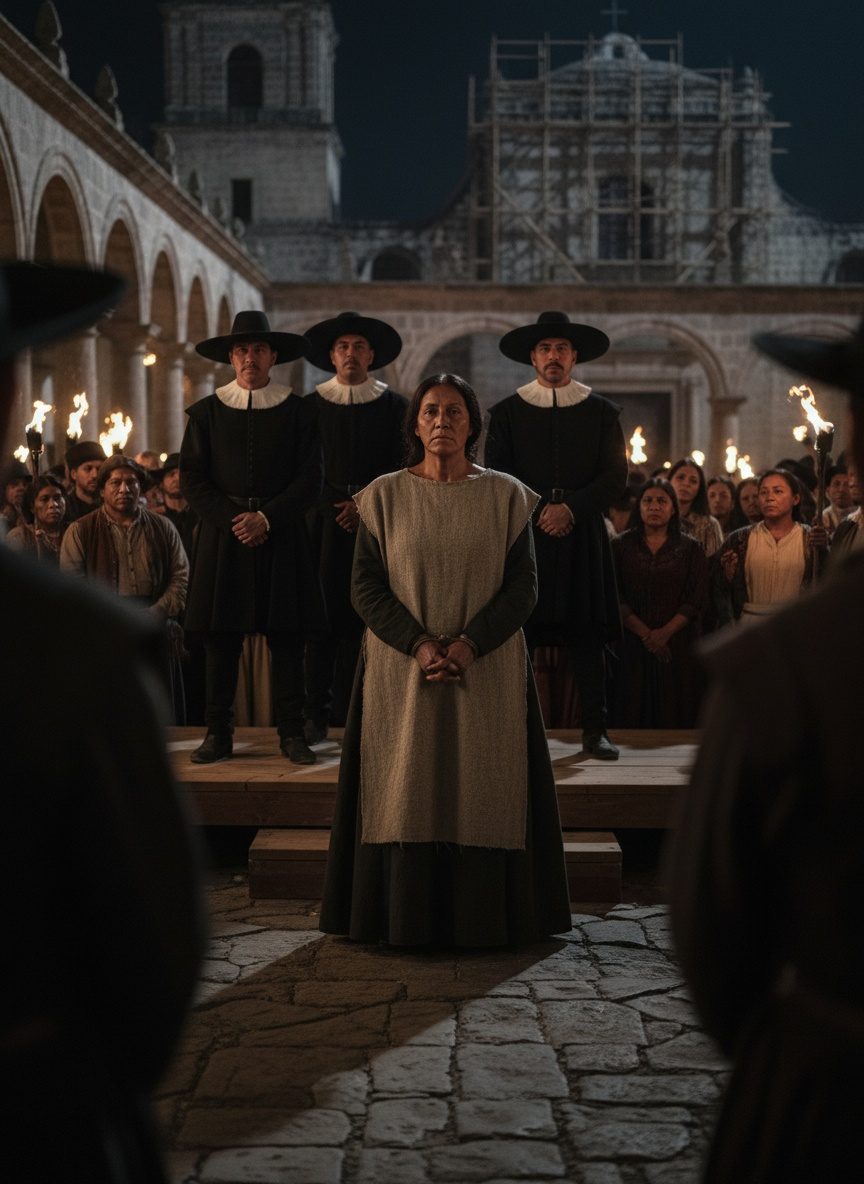
In the vibrant heart of New Spain, where towering cathedrals overshadowed ancient pyramids, the Inquisition's shadow loomed ever larger. It was a city of contrasts, swirling with the convergence of old empire grandeur and new colonial zeal. Within this tense ambiance, María de Cazalla, a woman of unbreakable conviction, faced the unthinkable. Accused of heresy, she had preached ideas considered dangerous, challenging the stringent orthodoxies imposed by the colonizers.
She was an oddity to the Spanish authorities, not just for her gender but for her adamant refusal to recant her beliefs—a profound testament to her indomitable spirit. Her defiance resonated in a land now ruled by a fear of religious persecution, where to speak one's mind could quickly lead to an untimely end. Cazalla became a symbol, not only of resistance but of tragedy, as she walked toward the gathering smoke and whispering flames.
A Crowd's Silence
The people gathered—men, women, indigenous, mestizo, and European alike—stared in morose fixation. They knew the script: a chance to recant, a path to salvation offered before the flames took hold. But María de Cazalla defied them, standing resolute, her voice silent but more resonant than ever. Her silence wasn't one of submission, but a rebellious shout against the cacophony of conformist whispers.
As the flames crackled to life, leaping to embrace the accused, the crowd remained still, their fates and senses bound to the heretical rupture now playing out. Each flicker of flame was a stark reminder of the perilous tightrope each colonist walked, straddling legacy and law. The smell of burning wood mingled with the pungent aroma of fear, leaving an imprint on history as strong as any carved stone.
Echoes of Defiance
In that moment of devastation, María became a beacon whose light, albeit extinguished by death, radiated far across time and geography. Her story, though not recorded extensively in the annals of history, quietly inspired ripples of dissent. Those who heard of the trial and its pending execution were reminded of the complexities of belief and the high cost of personal truth.
For the indigenous peoples of the land, still grappling with the imposition of a foreign faith—a foreign God—Cazalla's determination carried a dual edge of caution and courage. Subdued whispers in hidden corners of the city spoke of her, prophetic in their awe, half cautionary tale and half whispered reverie of an impossible dream.
An Enduring Signal
In the wake of her execution, the message sent by the colonial powers was unequivocal: conformity was survival. Yet even within this ironclad warning, María de Cazalla's story left a spark. Her tale, rarely spoken of in classrooms, was passed in hushed tones among those who dared question, serving as a quiet reminder that one's voice, even if snuffed out by fire, could linger and inspire.
This impactful stand, often glossed over in the grand narrative of colonization, demonstrates the profound struggle between faith, power, and individuality. It serves as an enduring question for all societies—Are we free to believe as we choose, or are we prisoners of the status quo and its authoritative enforcers? María's final silence was not an end, but rather an echo into the void of an unyielding testament to belief and the resilience of the human spirit.