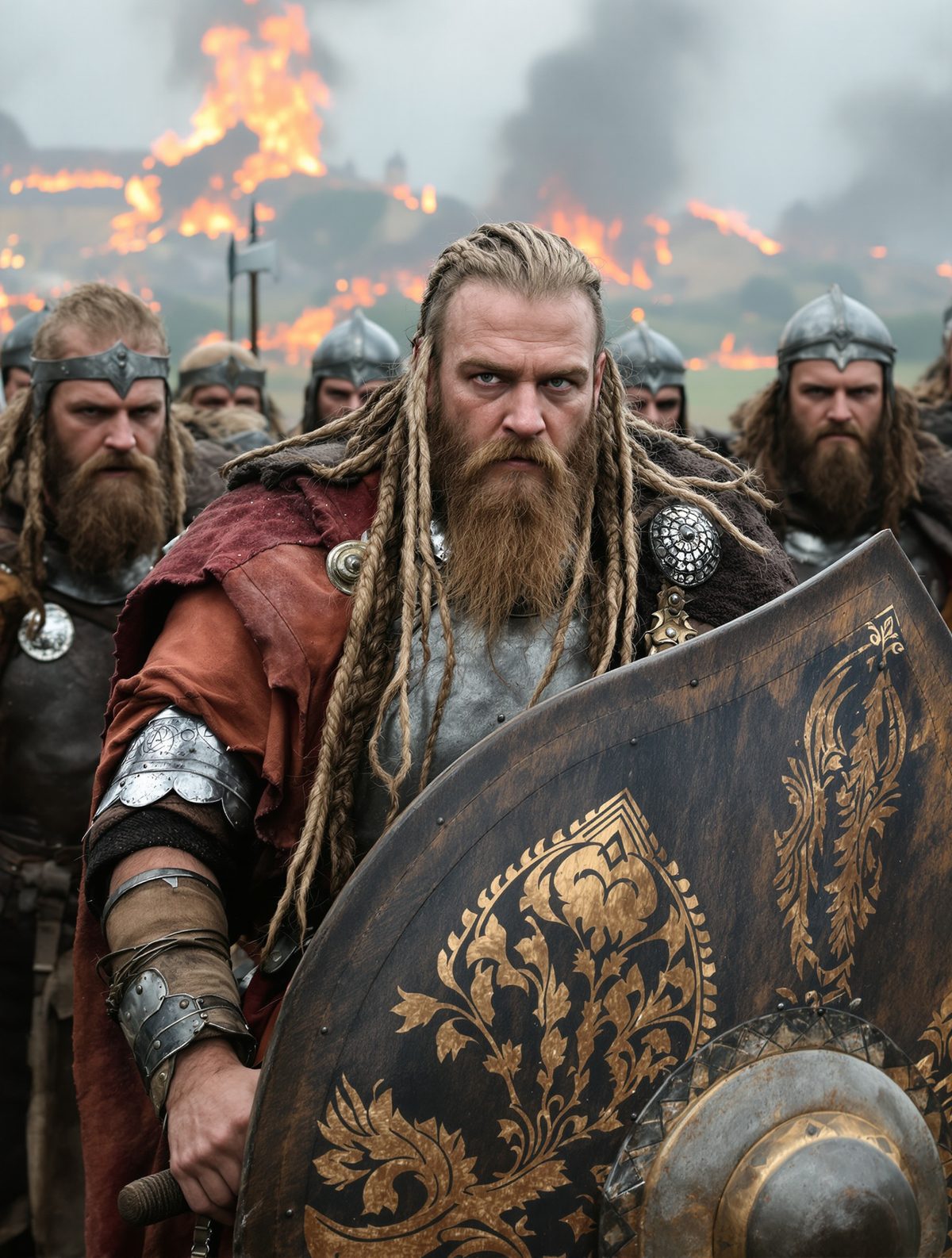
Picture this: It's a crisp autumn day in 865 AD, somewhere in the windswept hills of Northumbria. In a stone-lined pit barely six feet wide, dozens of venomous adders writhe in a seething mass of scales and fangs. Above them, guards drag a bound prisoner to the edge—a grizzled warrior whose reputation has terrorized the coasts of Europe for decades. As they prepare to lower him into his living tomb, the man does something that chills his captors to the bone. He throws back his head and laughs.
This wasn't just any warrior meeting his doom. This was Ragnar Lodbrok—literally "Hairy Breeches"—perhaps the most legendary Viking king who ever lived. And he was about to die in the most Viking way imaginable: defiant, fearless, and composing poetry as serpents sank their fangs into his flesh.
The Making of a Legend: Who Was Ragnar Lodbrok?
Separating fact from legend when it comes to Ragnar Lodbrok is like trying to untangle a ship's rigging in a hurricane. The historical Ragnar was likely a composite of several real Viking leaders who terrorized medieval Europe between 840 and 865 AD. What we do know is that he became the stuff of legend—a king whose very name could empty coastal villages from Ireland to the Mediterranean.
According to the sagas, Ragnar earned his peculiar nickname from a pair of leather pants boiled in pitch that he wore to protect himself from a giant serpent while wooing his first wife, Thora. The irony that he would later die from snake bites wasn't lost on medieval chroniclers, who loved such poetic justice. But Ragnar was far more than a colorful nickname and a tragic end.
He was reportedly the father of some of the most feared Vikings in history: Ivar the Boneless, Bjorn Ironside, Hvitserk the Swift, and Sigurd Snake-in-the-Eye. Together, this dynasty of warriors would reshape the political landscape of medieval Europe. Ragnar himself led devastating raids on Paris in 845 AD, extracting a ransom of 7,000 pounds of silver from the Frankish king Charles the Bald—roughly equivalent to $2.8 million today.
But perhaps most importantly, Ragnar embodied the Viking ideal of living boldly and dying memorably. In a culture that believed your reputation was the only thing that survived death, Ragnar was building himself an eternal legacy with every raid, every victory, and every act of audacious courage.
The Fatal Voyage: How a King Became a Prisoner
By 865 AD, Ragnar was no longer the young warrior who had terrorized the Seine River twenty years earlier. Some sources suggest he was driven by a need to prove he could still match the exploits of his sons, who had been carving out their own legendary reputations across Europe. Others hint at a darker motivation—perhaps Ragnar knew his time was ending and wanted to choose his own dramatic exit from the world's stage.
Whatever drove him, Ragnar made a fateful decision to launch a raid on the kingdom of Northumbria in northern England. But this wasn't the meticulously planned expedition of his youth. According to the Ragnarssona þáttr (Tale of Ragnar's Sons), he set sail with just two ships—a fraction of the fleet that had once made the Frankish Empire tremble.
The voyage went wrong from the start. Storms battered his small fleet in the North Sea, and one of his ships was lost entirely. When Ragnar finally made landfall on the English coast, he found himself vastly outnumbered and cut off from any hope of reinforcement or retreat.
King Aelle of Northumbria had been waiting for just such an opportunity. The Northumbrian king had suffered under Viking raids for years and harbored a particular hatred for Ragnar, whose earlier expeditions had left Northumbrian monasteries in ashes and filled with corpses. When word reached Aelle that the legendary Viking king had landed with barely a hundred men, he mobilized his entire army.
The battle was swift and decisive. Ragnar's warriors, outnumbered perhaps ten to one, fought with the desperate fury of men who knew they would never see their homeland again. But courage alone couldn't overcome such overwhelming odds. When the last of his men fell, Ragnar found himself bound in chains, a prize more valuable to King Aelle than all the gold in Northumbria.
The Snake Pit: A Death Worthy of Legend
King Aelle faced a dilemma. Simply executing Ragnar with a sword would be too quick, too honorable for a man who had brought so much suffering to Christian lands. The Northumbrian king wanted Ragnar's death to serve as both revenge and warning—a spectacle that would demonstrate the fate awaiting any Viking who dared set foot on English soil.
The solution was as creative as it was cruel: a specially constructed pit filled with venomous snakes. Medieval chroniclers describe a stone-lined chamber, roughly six feet across and eight feet deep, into which dozens of adders and other poisonous serpents had been collected. It was a death designed to inspire maximum terror and suffering.
But Ragnar Lodbrok was not a man easily terrified. As his captors dragged him to the edge of the pit, something extraordinary happened. Instead of pleading for mercy or raging against his fate, Ragnar began to laugh—not the bitter laugh of a broken man, but the hearty, booming laughter of a warrior who had just heard an excellent joke.
The laughter continued even as they lowered him into the pit. As the first snakes struck and venom began coursing through his veins, Ragnar's voice rose not in screams but in song. He had begun composing his death-song—the Krákumál—a final poem that would ensure his name lived forever.
"We hewed with our swords!" he sang, his voice echoing from the stone walls as serpents coiled around his legs. "Gladly do I go!" The Vikings believed that a warrior's final words could shape his entire legacy, and Ragnar was determined to craft his masterpiece while dying.
The Death Song: Poetry Written in Venom
The Krákumál that Ragnar composed in his final moments survives to this day—sixty stanzas of defiant verse that chronicle his life's greatest victories while venom slowly shut down his body. It's one of the most remarkable pieces of medieval literature, not just for its content but for the circumstances of its creation.
As more snakes struck and his vision began to blur, Ragnar sang of battles fought and enemies conquered. He recalled raiding in the Baltic, fighting in Russia, and the day he made the mighty Charles the Bald pay tribute rather than fight. "Eagerly shall I drink ale in the high-hall with the Æsir," he declared, invoking the Viking belief that warriors who died bravely would feast with the gods in Valhalla.
But the most chilling stanza came near the end, as death finally began to claim him. "The piglets would grunt if they knew what the old boar suffers," Ragnar sang, using a metaphor his captors couldn't possibly understand. The "piglets" were his sons, scattered across Europe but bound to learn of their father's fate. And when they did, Ragnar promised, the revenge would be terrible to behold.
Contemporary accounts suggest that even King Aelle and his men fell silent as they listened to this extraordinary death song. Here was a man being slowly killed by dozens of venomous snake bites, and he was using his final breaths not to beg for mercy but to compose poetry and threaten revenge from beyond the grave.
When Ragnar finally fell silent, sometime during the night of that autumn day in 865 AD, legend says the snakes themselves seemed to retreat from his body. The Viking king had died as he had lived—on his own terms, leaving behind words that would outlive kingdoms.
The Great Heathen Army: When Piglets Became Wolves
Ragnar's prophecy about his "piglets" proved devastatingly accurate. When word of their father's death reached his sons, they set aside their own conflicts and united for one purpose: revenge on a scale that medieval Europe had never seen.
In 866 AD, just one year after Ragnar's death, the largest Viking army ever assembled landed on English shores. The Anglo-Saxon Chronicle called it the "Great Heathen Army"—a force so massive it would spend the next fourteen years conquering most of England. Leading this army of vengeance were Ragnar's sons: Ivar the Boneless with his brilliant tactical mind, Halfdan Ragnarsson with his berserker fury, and Ubba the Terrible with his unstoppable fleet.
King Aelle's fate was sealed the moment he chose that snake pit. When the sons of Ragnar finally captured him in 867 AD, they subjected him to the "blood eagle"—one of the most horrific execution methods in human history, where the victim's ribs were cut away from the spine and their lungs pulled out to form the shape of wings. It was revenge that made even hardened Vikings blanch, but Ragnar's sons considered it a fitting tribute to their father's memory.
The Great Heathen Army went on to conquer Northumbria, East Anglia, and Mercia, establishing Viking kingdoms that would endure for centuries. In a very real sense, Ragnar's death in that snake pit triggered the Viking conquest of England—making his final prophecy one of the most consequential death-bed predictions in medieval history.
Why Ragnar's Last Laugh Still Echoes Today
More than a thousand years later, why does the story of a Viking king dying in a snake pit still captivate us? Perhaps because Ragnar Lodbrok's final moments represent something that transcends historical period or culture: the power of facing death on your own terms.
In an age of social media and instant global communication, we're constantly aware of how our actions and words will be remembered. Ragnar understood this principle intuitively—he knew that his reputation would outlive his body, so he invested his final moments in crafting a legacy that would inspire fear, respect, and storytelling for generations.
But there's something deeper here too. Ragnar's laughter in the face of death wasn't just bravado—it was a fundamental rejection of his enemies' power over him. King Aelle could control how Ragnar died, but he couldn't control how Ragnar chose to die. That distinction made all the difference between a gruesome execution and a legendary martyrdom.
Today, when we face our own challenges and setbacks, Ragnar's example reminds us that our response to adversity often matters more than the adversity itself. We may not be facing venomous serpents in a stone pit, but we all encounter moments when our character is tested and our legacy is shaped by how we choose to respond.
The Viking king who died laughing in a snake pit, composing poetry as venom flowed through his veins, achieved something that all his successful raids and accumulated treasure never could: true immortality. His name still echoes through popular culture, from television shows to heavy metal songs, because he understood a truth that transcends time—sometimes the most important victory is simply refusing to be defeated, even in death.