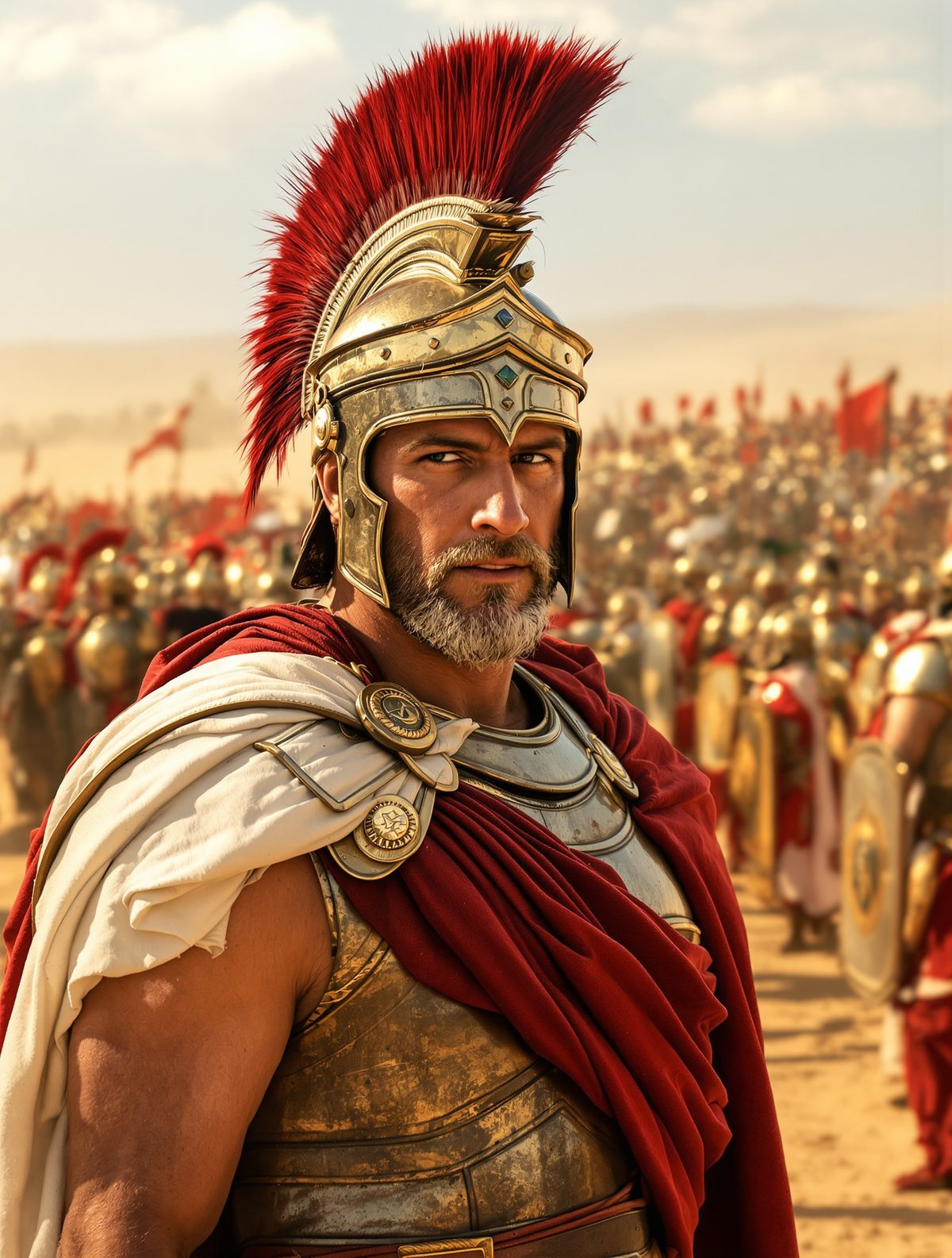
Picture this: you're an ordinary Athenian citizen in 556 BC, going about your daily business in the agora, when suddenly the ground begins to tremble with the sound of approaching chariots. You look up to see a procession unlike anything you've ever witnessed—a towering figure in gleaming armor and flowing robes, owl perched on her shoulder, spear glinting in the Mediterranean sun. It's Athena herself, patron goddess of your city, and she's personally escorting a familiar face back to Athens: the exiled tyrant Pisistratus.
What unfolds next is perhaps history's most brazen act of political theater, a scheme so audacious it would make modern spin doctors weep with envy. But here's the twist that makes this story truly extraordinary: the "goddess" wasn't divine at all. She was Phye, a remarkably tall market woman who had just pulled off the greatest con in ancient Greek history.
The Tyrant in Exile: A Desperate Man's Dilemma
To understand how Pisistratus ended up orchestrating this divine deception, we need to rewind a few years. Athens in the 6th century BC was a powder keg of political tension. The city-state was torn between three feuding factions: the pedieis (the wealthy plains dwellers), the paralioi (the moderate coastal people), and the diakrioi (the hill people and poor farmers). Into this chaos stepped Pisistratus, a charismatic military commander who positioned himself as champion of the common people.
Pisistratus first seized power around 561 BC through a spectacular piece of political theater—he wounded himself and his mules, then rode into the agora claiming he'd been attacked by political enemies. The shocked Athenians, believing he needed protection, granted him a bodyguard of club-bearers. Big mistake. He promptly used these "bodyguards" to seize the Acropolis and declare himself tyrant.
But power in ancient Athens was slippery. Within a few years, his political enemies had united against him, and Pisistratus found himself unceremoniously booted from the city. By 556 BC, he was plotting his return from exile, and conventional military approaches seemed doomed to failure. He needed something bigger, something that would bypass political opposition entirely. He needed divine intervention—or at least the appearance of it.
Enter Phye: The Goddess Next Door
Here's where our story takes a turn that would make Hollywood screenwriters jealous. Somewhere in the markets and neighborhoods around Athens, Pisistratus or his agents discovered a woman named Phye. Ancient sources describe her as unusually tall—some accounts suggest she stood nearly six feet, practically gigantic by ancient standards when the average person barely reached five feet. But height wasn't her only qualification for the role of a lifetime.
Phye possessed what we might call "goddess potential." She was reportedly beautiful, with a naturally commanding presence that could pass for divine authority. Most importantly, she bore a striking resemblance to the way Athenians imagined their patron goddess Athena—tall, imposing, and radiating an aura of wisdom and power.
The plan that emerged was breathtaking in its simplicity and audacity. Pisistratus would dress Phye as Athena, complete with the goddess's traditional armor, spear, and shield. She would drive a chariot into Athens while he rode alongside, giving every appearance that the city's patron deity was personally endorsing his return to power. It was the ancient equivalent of having God himself appear at a political rally.
The Grand Performance: Divine Theater Comes to Athens
The execution of this scheme required meticulous planning. Pisistratus couldn't simply show up at the city gates—the spectacle needed to be perfect from the moment Athenian eyes fell upon it. So the conspirators staged their divine appearance at Phaleron, a coastal area south of Athens, giving them a dramatic approach route that would maximize the visual impact.
When the procession began, it must have been a sight to behold. Phye, transformed into the goddess of wisdom and warfare, stood tall in her chariot, bronze armor gleaming, her spear raised toward the heavens. Sacred owls—Athena's symbolic birds—likely perched nearby. Pisistratus rode beside her, positioning himself not as her equal, but as her chosen mortal champion.
But here's the detail that makes this story even more incredible: Pisistratus had advance men running ahead of the procession, spreading word throughout Athens that Athena herself was bringing their beloved leader home. By the time the divine chariot reached the city proper, crowds had gathered along every street and rooftop.
The reaction was everything Pisistratus could have hoped for and more. Ancient historian Herodotus tells us that Athenians fell to their knees as the procession passed, praying to what they believed was their patron goddess. Some accounts suggest people wept with religious ecstasy, overwhelmed by this apparent divine visitation. The entire city surrendered to the illusion.
The Illusion Succeeds: A Bloodless Coup
What happened next demonstrates the incredible power of religious belief in ancient societies. Faced with what appeared to be divine endorsement, Pisistratus's political opponents simply melted away. How do you argue with a goddess? His enemies, who had successfully expelled him through political maneuvering, found themselves helpless against this spiritual trump card.
Pisistratus reclaimed power without a single sword being drawn. The coup was so smooth, so psychologically devastating to his opposition, that he faced virtually no resistance. Phye had given him something no army could provide: the appearance of divine legitimacy.
But the story doesn't end there. Once safely reinstalled as tyrant, Pisistratus faced the delicate question of what to do with his divine accomplice. Ancient sources suggest he rewarded Phye handsomely and arranged for her to marry a prominent citizen—though one wonders what dinner party conversations were like in that household. "So, dear, tell us again about the time you impersonated a goddess?"
More remarkably, despite the deception being discovered (Herodotus wouldn't have been able to write about it otherwise), Pisistratus remained popular with the Athenian people. This suggests that many citizens appreciated the theatrical genius of the scheme, even if they'd been temporarily fooled by it.
The Tyrant's Golden Years: When Deception Led to Prosperity
Here's the twist that makes Pisistratus's story even more fascinating: his divine con job actually led to some of Athens's most prosperous years. Once back in power, he proved to be remarkably effective as a ruler. He launched massive public works projects that employed thousands of citizens, established traveling judges to bring justice to rural areas, and supported the arts on an unprecedented scale.
Under his rule, Athens began its transformation from a struggling city-state into the cultural powerhouse that would later give birth to democracy, philosophy, and theater. The Panathenaic festival—ironically, a celebration of the very goddess Phye had impersonated—became one of Greece's most spectacular religious celebrations under his patronage.
Pisistratus ruled successfully until his natural death in 528 BC, having turned his moment of audacious deception into decades of genuine achievement. His sons inherited power, though they lacked their father's political genius and were eventually overthrown, paving the way for the democratic reforms of Cleisthenes.
The Eternal Con: What Phye's Performance Teaches Us Today
The story of Pisistratus and Phye might seem like ancient history, but it reveals timeless truths about power, perception, and the theater of politics that remain startlingly relevant today. In our age of carefully staged photo ops, viral social media campaigns, and political spectacle, Pisistratus's divine chariot ride feels remarkably contemporary.
Consider how modern politicians still seek to wrap themselves in symbols of authority and legitimacy—whether it's speaking from the steps of important buildings, surrounding themselves with flags, or timing announcements for maximum visual impact. Pisistratus understood something that every successful leader since has grasped: sometimes the appearance of legitimacy matters more than legitimacy itself.
But perhaps most remarkably, Phye's performance reminds us that history's most pivotal moments sometimes hinge on the courage of ordinary people willing to play extraordinary roles. A market woman's willingness to dress as a goddess changed the course of Athenian history and contributed to the foundation of Western civilization. In a world where we often feel powerless against vast political and social forces, that's a reminder worth remembering: sometimes the most audacious act of theater can reshape everything.
After all, if you're going to stage a comeback, you might as well do it with a goddess driving the getaway chariot.