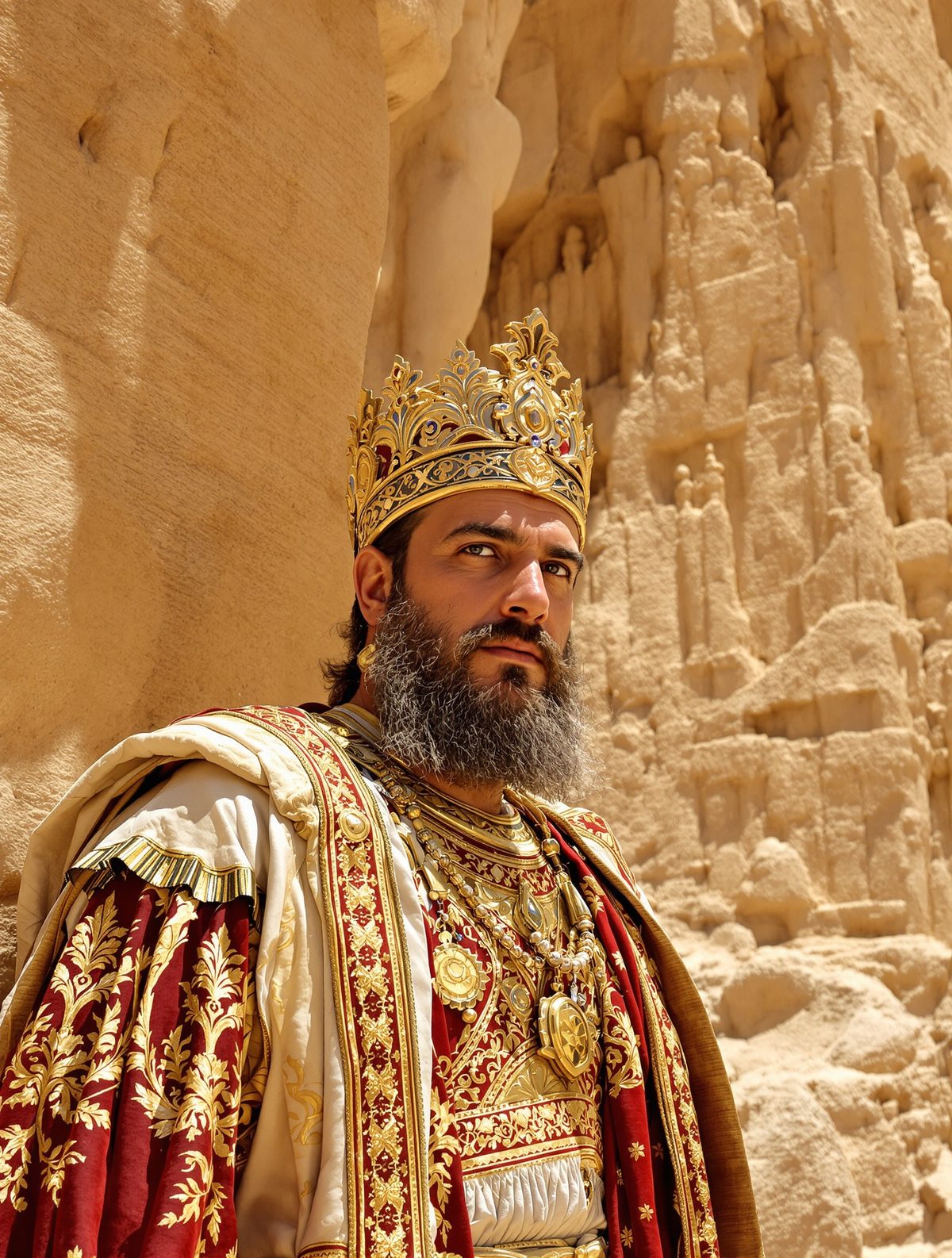
Picture this: the most powerful throne room in the ancient world, circa 2250 BC. Gleaming limestone columns stretch toward painted ceilings depicting gods and conquests. Gold catches the light from oil lamps, casting dancing shadows across hieroglyph-covered walls. At the center of it all sits a boy-king on his golden throne, barely ten years old, wielding absolute power over three million subjects along the Nile.
But there's something deeply unsettling about this scene. Surrounding the child pharaoh stand a dozen naked men and women, their bronze skin glistening with thick honey from head to toe. They remain perfectly motionless, like human statues, as hundreds of flies buzz around them, becoming trapped in the sticky amber coating their bodies. Welcome to the bizarre court of Pepi II Neferkare, whose creative solution to a pest problem would become one of ancient Egypt's most disturbing legends.
The Boy Who Would Be God
When Pepi II ascended to the throne of Egypt around 2278 BC, he was likely no more than six years old. The Old Kingdom was at its zenith—the Great Pyramid of Giza had already stood for over two centuries, and Egyptian civilization dominated the known world. But governing an empire stretching from Nubia to the Levant proved challenging even for seasoned rulers, let alone a child who should have been playing with wooden toys and pet monkeys.
Young Pepi II faced the same divine expectations as any pharaoh before him. He was considered the living embodiment of Horus, the falcon god, and later would join Ra in the afterlife. Every public appearance was a religious ceremony, every royal audience a sacred ritual. The pharaoh could show no weakness, no discomfort, no human frailty that might suggest the gods had chosen poorly.
Which made his problem with flies particularly inconvenient.
Ancient Egypt, for all its grandeur, was a land plagued by insects. The annual Nile floods that brought life to the desert also brought swarms of flies, mosquitoes, and gnats. Even the wealthiest households battled constant invasions of buzzing pests. But while commoners could swat freely at annoying insects, a divine pharaoh could not be seen flailing his arms or showing irritation during solemn court proceedings.
A Sticky Solution to a Buzzing Problem
The solution that emerged from Pepi II's court was as ingenious as it was horrifying. Rather than suffer through fly-plagued ceremonies, the young pharaoh's advisors—or perhaps the precocious boy himself—devised a human fly-trap system that would make the throne room pest-free.
Palace servants were stripped naked and coated entirely in honey, creating living, breathing flypaper. These unfortunate individuals were then positioned strategically around the throne room, where they would stand motionless for hours during royal audiences. The sweet honey attracted every fly in the vicinity, and the insects became helplessly stuck to the servants' skin.
The honey used was likely the thick, amber variety harvested from clay cylinder hives that Egyptian beekeepers had perfected over millennia. This wasn't the processed honey we know today—it was a thick, sticky substance that would coat human skin like varnish and trap even the most determined fly. Applied from head to toe, it would have made breathing difficult and movement nearly impossible.
Contemporary accounts, preserved in fragmentary papyri and later Egyptian chronicles, suggest that a rotation of servants endured this treatment. Some sources indicate that as many as twenty people might be coated in honey and positioned throughout the vast throne room during major ceremonies.
The Human Cost of Royal Comfort
For the servants selected for honey duty, the experience was nothing short of torturous. Imagine standing completely still for three to four hours, unable to breathe properly through your honey-coated nostrils, feeling hundreds of flies landing on your body and struggling against the sticky trap of your skin. The psychological trauma of being reduced to a piece of furniture—a living pest control device—must have been devastating.
Egyptian records suggest that servants occasionally collapsed during these ordeals. The combination of restricted breathing, physical exhaustion, and the psychological stress of absolute stillness while covered in insects proved too much for some. When a servant fell, others would quickly drag them away and take their position, ensuring the pharaoh's comfort was never interrupted.
The removal of the honey afterward presented its own horrors. Scraping away the substance meant removing layers of skin along with the trapped flies. Servants often suffered infections from the wounds, and some died from complications. Yet the practice continued for decades, a testament to the absolute power of pharaonic authority and the expendability of human life in service to divine kingship.
What makes this practice even more disturbing is that many of these servants were likely children themselves—palace workers often came from families who sold their children into royal service during times of famine or economic hardship.
Scandal in the Sacred Palace
Even by ancient Egyptian standards, Pepi II's fly-trap humans raised eyebrows. Fragmentary records from the period suggest that some high-ranking courtiers and priests found the practice excessive. One partially preserved papyrus mentions "whispers in the sacred halls" about the young pharaoh's methods.
The scandal wasn't necessarily about the cruelty—ancient Egypt was built on slave labor, after all. Rather, court officials worried about the religious implications. Having naked, honey-covered humans standing in the sacred space where pharaoh communed with the gods struck some as potentially blasphemous. There were concerns that such practices might anger the deities and bring misfortune to the kingdom.
These concerns proved somewhat prophetic. Pepi II's reign, while lasting an incredible 94 years (the longest in Egyptian history), saw the gradual decline and eventual collapse of the Old Kingdom. By the end of his reign, central authority had weakened dramatically, and Egypt would fragment into competing regional powers during the chaotic First Intermediate Period.
Some later Egyptian chroniclers would point to Pepi II's various excesses—including his human fly-traps—as evidence that the gods had withdrawn their favor from the boy-king who never truly grew into wisdom.
The Long Reign of a Child's Whims
What makes Pepi II's fly-trap servants particularly fascinating is how this childhood solution to a minor problem became institutionalized across nearly a century of rule. Most pharaohs who took the throne as children eventually outgrew their juvenile impulses as adult advisors gained influence. Not Pepi II.
Historical evidence suggests the honey-coated servants continued appearing at court ceremonies well into Pepi II's adult years, possibly until his death around 2184 BC. What began as a creative solution to a boy's annoyance with buzzing flies became a permanent fixture of royal protocol. Palace records indicate that specific servants were designated as "honey bearers" and "fly catchers," suggesting the practice became a recognized court position.
The persistence of this bizarre tradition reflects something profound about absolute power and its corrupting influence. When no one can say "no" to you, when your every whim becomes law, even the most outrageous childhood ideas can become entrenched systems that outlast their usefulness—or any rational justification.
Pepi II's reign ultimately lasted so long that he outlived most of his children and potential successors, leaving Egypt without clear leadership and contributing to the kingdom's collapse. His refusal to adapt or mature, symbolized by practices like the human fly-traps, may have doomed one of history's greatest civilizations.
Legacy of the Honey-Coated Court
The story of Pepi II's human fly-traps offers us a disturbing window into how power operates when completely unchecked. Here was a child who never had to grow up, never had to consider the human cost of his comfort, never had to question whether his solutions were proportional to his problems.
In our modern world, we like to think we've evolved beyond such casual cruelty. Yet the fundamental dynamic—powerful people insulating themselves from minor inconveniences at tremendous cost to others—remains depressingly familiar. How many contemporary "solutions" to elite comfort come at the expense of those with no voice, no choice, no power to refuse?
Pepi II ruled Egypt longer than any pharaoh in history, but his legacy isn't the monuments he built or the territories he conquered. Instead, he's remembered for honey-covered humans standing motionless in his throne room, a perfect metaphor for power that never learned the difference between what it could do and what it should do.
The flies, incidentally, returned every single day. But the servants who caught them were easily replaced.