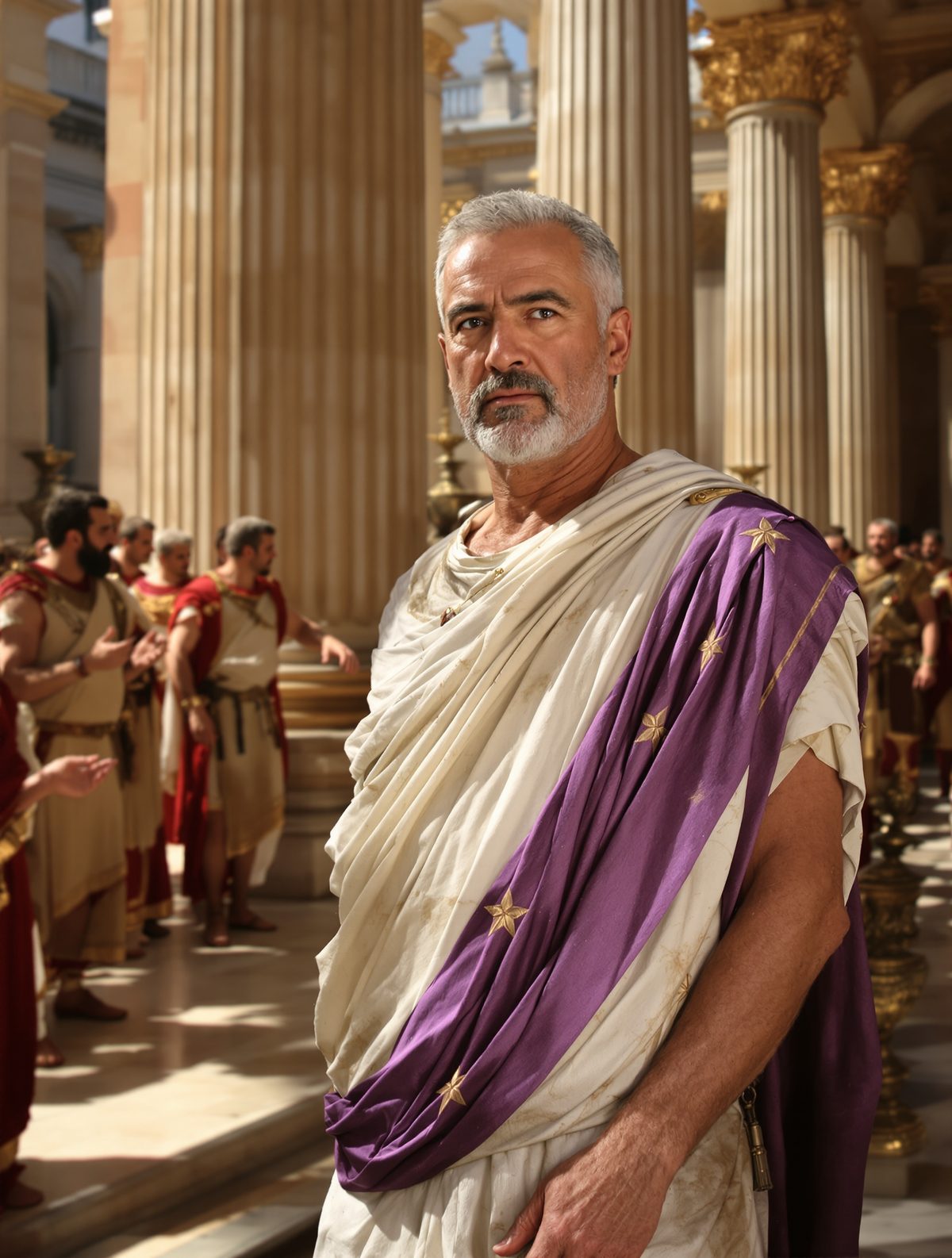
Picture this: you're a Roman soldier stationed on the frozen Danube frontier in 248 AD. Your emperor, Philip the Arab, sits comfortable in Rome while you face barbarian raids with dwindling supplies and months of unpaid wages. Then your charismatic general stands before you, coins bearing his own face glinting in his palm, and declares himself the rightful ruler of the Roman Empire. For a moment, it seems possible. For exactly three months, it was real. Then everything went catastrophically, brutally wrong.
This is the story of Titus Julius Priscus Pacatianus – a name history barely remembers, yet a man who dared to challenge the might of Rome itself. His rebellion lasted just ninety days, but in those three months, he minted currency, commanded legions, and genuinely threatened to tear the empire in two. His end was so violent, so final, that his own soldiers decapitated him and shipped his severed head hundreds of miles to prove their loyalty to the true emperor.
The Crisis That Made Rebellion Possible
To understand Pacatianus, you must first grasp the chaos consuming the Roman Empire in 248 AD. This was the heart of what historians call the "Crisis of the Third Century" – a fifty-year period when the empire nearly collapsed under the weight of civil wars, barbarian invasions, economic collapse, and plague. In just fifty years, more than twenty emperors would claim the throne, most meeting violent deaths.
Emperor Philip the Arab had seized power in 244 AD after orchestrating the murder of the nineteen-year-old Emperor Gordian III. Philip was an outsider – born in what is now Jordan, he was the first Arab to rule Rome. This made him vulnerable. The Roman elite whispered that a barbarian sat on the throne of Augustus, while the legions grumbled about an emperor who had never earned their respect through conquest.
The Danube provinces, where Pacatianus served as governor, were particularly restless. These frontier regions bore the brunt of barbarian attacks while receiving little support from Rome. Gothic tribes pressed against the borders, inflation ravaged the economy, and soldiers' pay arrived months late – if at all. The stage was set for rebellion.
A General's Gamble
Titus Julius Priscus Pacatianus wasn't some minor provincial nobody. He was praeses (governor) of Moesia, a critical Danube province, and commanded significant military forces. Ancient sources describe him as experienced and well-regarded by his troops – exactly the kind of man who could convince battle-hardened legionaries to commit treason.
In late 248 AD, Pacatianus made his move. Standing before his assembled forces, he declared Philip a usurper and proclaimed himself Augustus – the rightful Roman Emperor. It was an audacious gamble that required split-second timing and absolute confidence. In the Roman world, hesitation meant death.
But here's what makes Pacatianus fascinating: he didn't just talk about being emperor – he acted like one immediately. Within days, he had established a functioning imperial administration. Most remarkably, he began minting his own coins, stamped with his portrait and the legend "IMP C TI IVL PRISCVS PACATIANVS AVG" – Emperor Caesar Titus Julius Priscus Pacatianus Augustus.
These coins weren't crude propaganda pieces hammered out in secret. They were professionally crafted silver and bronze denarii that could have passed for official imperial currency anywhere in the empire. The fact that Pacatianus could produce them so quickly suggests he had been planning this rebellion for months, secretly stockpiling silver and recruiting mint workers to his cause.
Emperor of the Danube
For three extraordinary months, Pacatianus ruled a shadow empire along the Danube. His territory likely included parts of modern-day Bulgaria, Serbia, and Romania – a substantial chunk of the Roman world, defended by battle-tested legions who had faced Gothic warriors in brutal frontier warfare.
What was daily life like in Pacatianus's empire? Ancient sources give us tantalizing glimpses. His coins circulated in markets from the Black Sea to the Carpathian Mountains. Provincial officials had to choose sides – remain loyal to distant Philip or bend the knee to the strong man who controlled their immediate fate. Many chose Pacatianus, calculating that a local emperor was better than an absent one.
The rebel emperor faced the same challenges that had driven him to rebellion in the first place. Gothic tribes didn't pause their raids because Romans were fighting Romans. Pacatianus had to simultaneously defend the frontier and prepare for the inevitable counterattack from Philip's forces. It was an impossible balancing act that would have tested even the most capable ruler.
Meanwhile, disturbing news arrived from other provinces. Another usurper, Jotapianus, had declared himself emperor in Syria. The empire was fracturing along multiple fault lines, with regional strongmen carving out their own domains. For a brief moment, it seemed possible that Philip's reign might collapse entirely, leaving the Roman world divided among competing warlords.
The Betrayal
But Roman soldiers were pragmatists above all else. They followed strength, and by early 249 AD, it was becoming clear that Pacatianus's strength was illusory. Philip's response had been swift and decisive – he dispatched his most trusted general, the future Emperor Decius, with a substantial army to crush the Danubian rebellion.
As Decius's legions approached, something shifted in the minds of Pacatianus's soldiers. Perhaps they realized their emperor's promises of victory were empty. Perhaps they calculated that backing a losing rebellion would mean death for them all. Perhaps they simply decided that three months of glory weren't worth a lifetime of punishment.
The end came suddenly and with shocking brutality. Pacatianus's own men turned on him, likely during a military council or while he slept in his command tent. They didn't just kill him – they butchered him, severing his head as proof of their deed and their renewed loyalty to Philip.
The decapitation wasn't random violence. In Roman culture, the head symbolized authority and identity. By removing Pacatianus's head and preserving it, his soldiers were making a calculated political statement. They were literally delivering his power and person to the rightful emperor.
A Head for an Emperor
Picture the scene: Imperial couriers racing across hundreds of miles of Roman roads, carrying a grisly package to Philip in Rome. Inside, the decomposing head of a man who had dared call himself Augustus. This wasn't just proof of death – it was a warning to any other potential rebels about the fate that awaited traitors.
Philip's reaction to receiving Pacatianus's head isn't recorded, but we can imagine his relief. The Danubian rebellion was finished, and his eastern flank was secure (Jotapianus had met a similar fate around the same time). For a brief moment, Philip's throne seemed stable.
But the reprieve was temporary. The very general Philip had sent to crush Pacatianus – Decius – would himself revolt and kill Philip within a year. It was a perfect illustration of the chaos consuming the Roman world. Today's loyal general was tomorrow's usurper, and yesterday's emperor was today's corpse.
Pacatianus's coins, ironically, outlasted both him and Philip. Archaeological discoveries continue to turn up his silver denarii across the former Roman world, each one a tangible reminder of a forgotten rebellion. These coins are now worth thousands of dollars to collectors – far more valuable than they ever were as currency.
The Emperor Who Almost Wasn't
Why does Pacatianus matter? In our modern world of stable governments and peaceful transitions of power, his story might seem like ancient chaos with little relevance. But look closer, and you'll see timeless truths about leadership, loyalty, and the fragility of political systems.
Pacatianus represents something we see repeatedly throughout history – the regional leader who believes they can do better than distant central authority. From Confederate generals to modern separatist movements, the pattern is always similar: local strongmen convince themselves and their followers that independence is preferable to integration.
His three-month empire also demonstrates how quickly political realities can shift. In January 249 AD, Pacatianus commanded legions and minted coins. By April, his head was rotting in an imperial palace. The distance between emperor and corpse proved to be exactly ninety days.
Perhaps most importantly, Pacatianus's rebellion illuminates the human cost of political instability. Every civil war, every usurpation, every violent power struggle meant real people suffered. Soldiers died for competing visions of Rome. Civilians watched their world tear itself apart. Economic systems collapsed under the weight of constant warfare.
In our own era of political polarization and institutional stress, Pacatianus's story serves as a reminder that even the mightiest civilizations can fracture when trust breaks down and regional interests override common purpose. The Roman Empire survived the Crisis of the Third Century, but it emerged fundamentally changed – more authoritarian, more militarized, and ultimately more fragile.
So the next time you hold a coin in your hand, remember Pacatianus. For three months, he commanded armies and ruled provinces, his face stamped on silver that circulated across an empire. Then his own men cut off his head and sent it to his enemy. In the space between those moments lies everything we need to know about power, ambition, and the thin line between emperor and executed traitor.