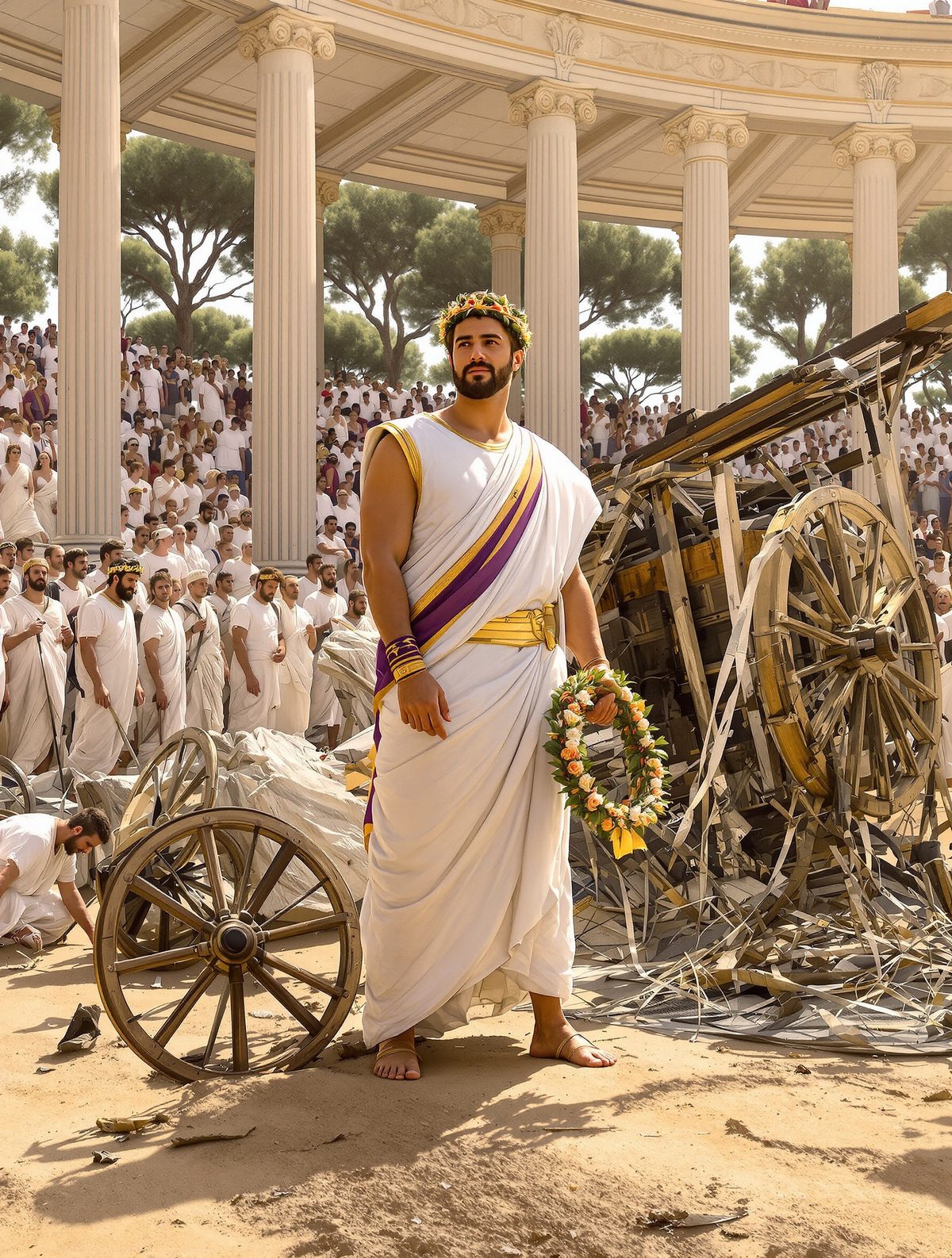
Picture this: You're standing in the grand plaza of Texcoco in 1431, watching something that would make even today's legal scholars stop and stare. Instead of dry recitations of statutes and penalties, the air fills with melodic verses as court officials chant the kingdom's laws like epic poetry. Citizens gather not just for justice, but for performance art that rivals Broadway. This wasn't some quirky legal experiment—it was the brilliant solution of a philosopher-king who understood something our modern world has forgotten: if you want people to follow laws, they first need to remember them.
Welcome to the revolutionary world of Nezahualcóyotl, the ruler who turned jurisprudence into poetry and transformed his courtrooms into concert halls.
The Philosopher on the Throne
Nezahualcóyotl wasn't your typical 15th-century monarch. Born around 1402, he spent his youth in exile after his father, King Ixtlilxóchitl I, was murdered by the rival Tepanec ruler Tezozómoc. For fifteen years, young Nezahualcóyotl lived as a refugee, dodging assassins and building alliances. But instead of spending his exile plotting revenge, he immersed himself in philosophy, poetry, and engineering. By the time he reclaimed his throne in 1431, he had become something unprecedented in the Americas: a renaissance man who would make even Leonardo da Vinci jealous.
His kingdom of Texcoco sat on the eastern shore of Lake Texcoco, forming part of the powerful Triple Alliance alongside Tenochtitlan and Tlacopan. But while his Aztec neighbors focused on military conquest and tribute collection, Nezahualcóyotl had grander ambitions. He envisioned a kingdom ruled not by fear or force, but by wisdom and justice accessible to every citizen—from noble lords to humble farmers.
There was just one problem: in a world without widespread literacy, how do you ensure that complex legal codes reach everyone equally?
When Justice Meets Poetry
Nezahualcóyotl's solution was nothing short of genius. Rather than following the traditional model of laws carved in stone or painted on bark paper—accessible only to the educated elite—he composed his entire legal framework as epic poems. These weren't simple rhyming couplets, but sophisticated verses that wove together legal principles, moral philosophy, and memorable narratives.
The king understood what modern neuroscience has since proven: the human brain is wired to remember patterns, rhythms, and stories far better than abstract rules. His legal poems employed complex meter, alliteration, and narrative structures that made even the most intricate regulations stick in listeners' minds like popular songs. Citizens could recite property laws while working in their fields or recall criminal penalties while sharing stories around evening fires.
Take, for example, his famous verses on theft: "Like the coyote who steals the farmer's corn / Brings hunger to his own cubs at dawn / So shall the thief who takes another's grain / Find his own stores scattered by the rain." These weren't just pretty words—they contained specific legal principles about property rights, proportional punishment, and community responsibility.
The Courtroom as Theater
Nezahualcóyotl's courts became legendary throughout Mesoamerica. Picture the scene: instead of stern judges reading from dusty scrolls, trained court officials would perform legal proceedings like theatrical productions. Accusers and defendants would present their cases within established poetic frameworks, while judges would render verdicts in verse that referenced the appropriate legal poems.
The king established a complex hierarchy of eighty different courts, each specializing in different types of cases and corresponding poetic traditions. The Supreme Court in Texcoco handled the most serious crimes and complex civil matters, with proceedings that could last for days as officials recited the relevant legal poetry, complete with musical accompaniment and dramatic gestures.
Foreign dignitaries often traveled hundreds of miles just to witness these proceedings. Spanish chroniclers, writing decades later, described courts where "justice was sung like hymns to the gods, and even the condemned would praise the beauty of their sentences." One Tlaxcalan ambassador reportedly said that losing a case in Texcoco was like being defeated by a master poet—painful, but somehow elevating.
Laws That Lived and Breathed
But Nezahualcóyotl's legal innovation went far beyond mere memorization techniques. His poetic laws created something unprecedented: a living legal system that could evolve and adapt while maintaining its core principles. Unlike static written codes, the oral tradition allowed for subtle modifications and interpretations that could address new situations without completely overthrowing established precedent.
The king composed over sixty major legal poems covering everything from marriage and inheritance to trade regulations and environmental protection. His environmental laws were particularly ahead of their time—he established protected forests, regulated hunting seasons, and imposed severe penalties for unnecessary destruction of natural resources. One of his most famous verses proclaimed: "The mountain that gives us wood and water / Is like a generous father to his daughter / Who destroys the gifts of stone and tree / Destroys the children yet to be."
These weren't just idealistic platitudes. Nezahualcóyotl backed his poetic principles with real enforcement. He created a network of traveling judges who would arrive in villages unannounced, test local officials on their knowledge of the legal poetry, and investigate whether the laws were being properly applied. Officials who couldn't recite the relevant legal verses were immediately dismissed—after all, how could they dispense justice they couldn't remember?
The Palace of Impossible Beauty
To support his revolutionary legal system, Nezahualcóyotl constructed what Spanish chroniclers later called "the most beautiful palace in the New World." His court complex in Texcoco featured elaborate gardens, astronomical observatories, libraries, and—most importantly—an acoustic marvel of a great hall designed specifically for legal poetry performances.
The hall's architecture amplified and clarified human voices without echo or distortion, allowing even whispered verses to reach every corner of the vast space. Engineers achieved this through precisely calculated angles, specially chosen building materials, and hidden acoustic chambers that remain mysterious even today. When court was in session, the building itself seemed to breathe with the rhythm of legal verse.
The palace also housed the kingdom's master poets and legal scholars, who worked continuously to refine and expand the legal poetry. These weren't just government employees—they were celebrities whose new compositions were eagerly anticipated throughout the kingdom. Citizens would gather in markets and plazas to hear traveling criers perform the latest legal verses, debating their meanings and implications with the enthusiasm modern audiences reserve for sports or entertainment news.
Legacy of the Singing Laws
Nezahualcóyotl's poetic legal system survived his death in 1472 and continued influencing Mesoamerican law for decades. Even after the Spanish conquest disrupted indigenous legal traditions, fragments of his legal poetry persisted in remote communities, passed down through generations like ancient folk songs.
Modern Mexico has begun recognizing Nezahualcóyotl as one of history's great legal innovators. The sprawling municipality of Ciudad Nezahualcóyotl, home to over one million people, bears his name. Law schools throughout Latin America study his integration of cultural expression with legal principle, and some contemporary indigenous communities have revived traditional oral legal practices inspired by his example.
But perhaps Nezahualcóyotl's greatest lesson for our digital age lies in his fundamental insight: laws are only as powerful as people's ability to understand and remember them. In our era of incomprehensible terms of service agreements and legal codes so complex that even lawyers struggle to navigate them, the poet-king's approach seems almost revolutionary again.
Imagine if our laws were written as stories we actually wanted to hear, as poems that stuck in our minds like favorite songs. Imagine if justice felt like art, and legal education felt like entertainment. Six centuries ago, in a palace on the shores of an ancient lake, one brilliant king proved it was possible. Perhaps it's time we started singing our laws again.