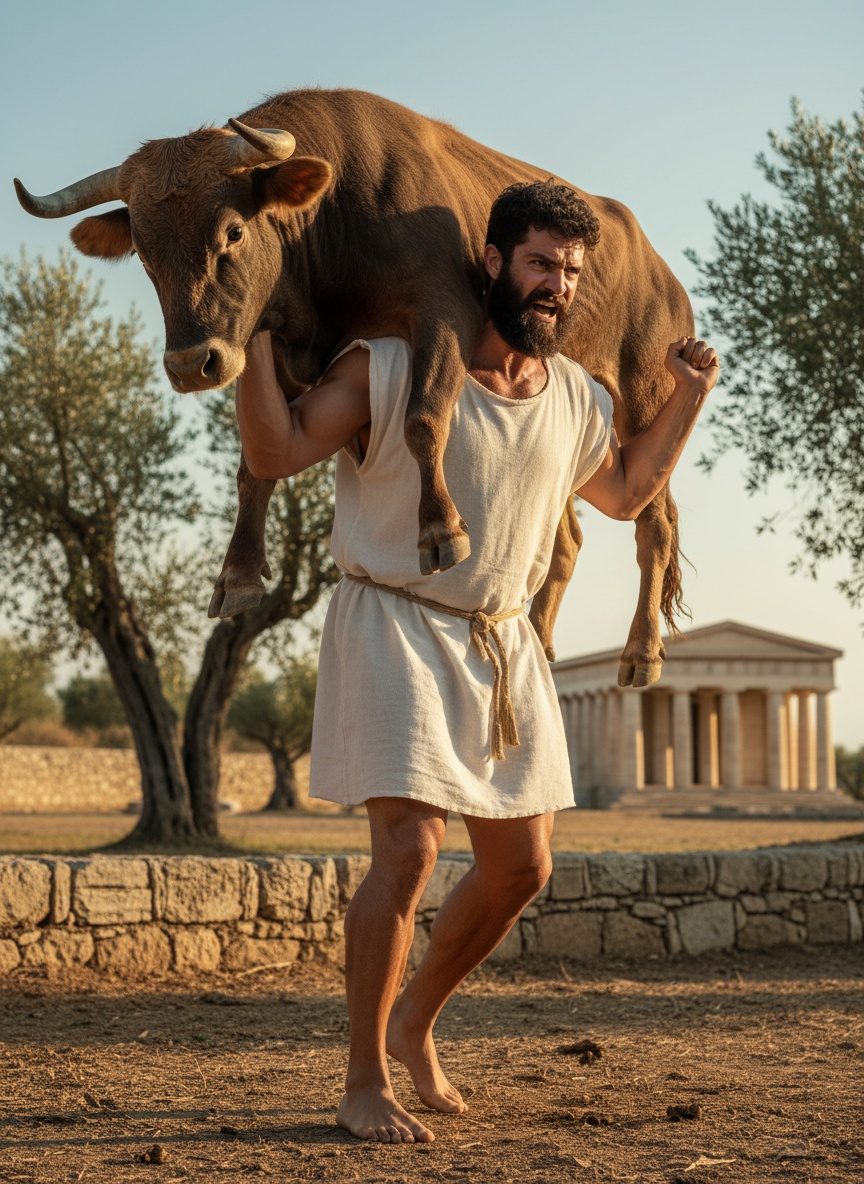
The morning sun cast a golden hue over the rolling hills of Croton. The cool breeze off the Ionian Sea was still, and birds greeted the dawn with a gentle chorus. Farmers were already at work in their fields, their silhouettes breaking the stillness of the landscape. As the small city stirred to life, a young boy set out on a ritual that was as curious as it was taxing. With determination reflected in his eyes, he swung a newborn calf across his shoulders, its lowing blending with the sounds of awakening life. Each day, he repeated this curious practice. Little did the inhabitants of Croton know that this boy’s humble effort to forge strength would shape him into one of the ancient world’s most celebrated athletes.
The Seeds of Strength
Milo of Croton’s journey began with a seemingly mundane task. Carrying a calf each morning might have been one of the simplest forms of exercise, yet it concealed a profound secret. This task was rooted in the principle known as progressive overload, a concept that would not be formally identified until two millennia later. As Milo voyaged down the beaten paths between the cityscape and open fields, the calf’s gradual growth imposed increasingly greater demands on his muscles. Though the motion each day was the same, the challenge intensified as the calf grew into a massive bull. This steadfast discipline honed Milo into a force of nature, ready to seize the opportunities that lay ahead in the realm of athletics.
Magic in the Arena
By the time Milo emerged on the competitive stage, his strength was legendary. Greece's athletic events were revered as tests not just of physical prowess, but of honor and civic pride. At every meeting, from the hallowed grounds of Olympia to the circuits of Delphi, spectators buzzed with tales of Milo’s feats. His physical power was matched by his strategic acumen—a rare combination that enabled him to be crowned champion at six Olympic Games, a staggering achievement in an era where the finest athletes competed for glory.
Among his numerous triumphs, Milo's most spectacular victory was in wrestling. Known for his iron grip and unparalleled endurance, he echoed with the exploits of the heroic Heracles. Stories of Milo breaking bands and lifting colossal weights were whispered throughout Greece, engraved in both history and myth. He became an idol, a living embodiment of what relentless sacrifice could attain.
Legacy of Labor
Beyond the accolades of the Games, Milo’s approach to training and his accomplishments resonated deeply with his contemporaries and with those in centuries to follow. His method of carrying a calf seemed straightforward, yet it was emblematic of life’s greatest lessons. The steady task highlighted the fusion of patience and perseverance, elevating it into a timeless allegory for human potential. Milo’s example spread across lands, inspiring others who hailed from Croton’s soil to nurture the seeds of discipline and growth.
Two millennia later, philosophers, sportsmen, and soldiers study the simplicity of Milo's technique. It was not merely his strength that left an indelible mark on history but his unyielding dedication. His pathway provided a template for understanding the necessity of consistent effort toward monumental achievement.
Stronger than the Stone
The story of Milo and his loyal calf-cum-bull is more than a relic of antiquity. It is a tale of tenacity and the power that small consistent efforts harbor. Where myths and reality intersect, Milo’s narrative provides more than an isolated snapshot from history. It offers an enduring message: that the pursuit of greatness does not demand grand starts, but rather the courage to embrace the steps leading towards it. As Milo lifted the bull that once was a calf, he laid the groundwork for the idea that through perseverance, impossible becomes routine. Though in the shadows of time, his story endures, challenging us to ask: What calf are we willing to carry today, so it may become tomorrow’s bull?