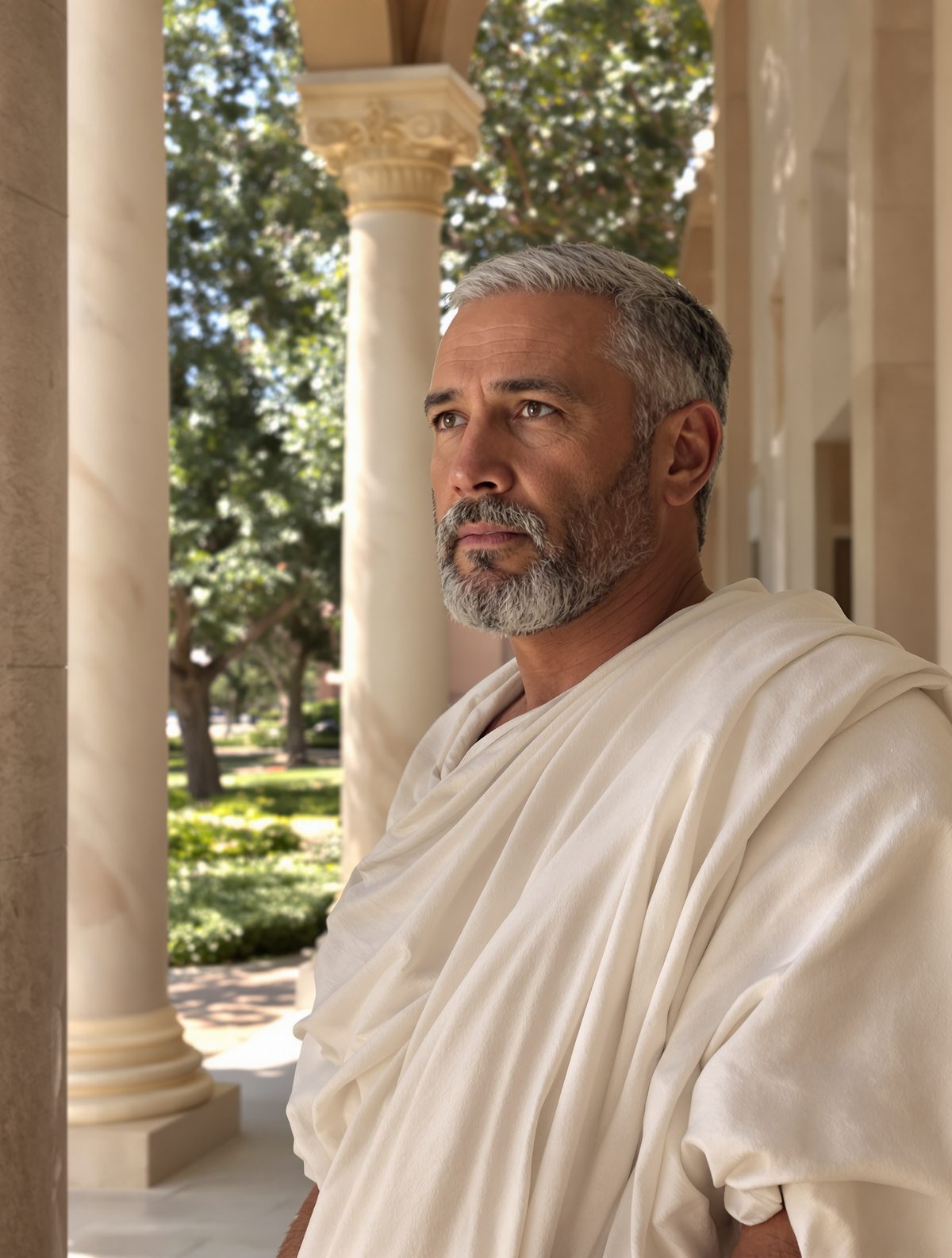
Picture this: You're a proud Greek scholar in 280 BC, basking in the glory of your civilization's achievements. Your people gave birth to democracy, philosophy, and theater. You've conquered the known world under Alexander the Great. Then an Egyptian priest walks into the Great Library of Alexandria and casually mentions that his people were already ancient when your ancestors were still figuring out agriculture.
That priest was Manetho, and the list he carried would shatter Greek assumptions about the antiquity of civilization forever.
The Shock of Deep Time
When Ptolemy II commissioned Manetho to write a history of Egypt around 280 BC, the request seemed straightforward enough. The new Greek rulers of Egypt wanted to understand their subjects' past—perhaps expecting a few centuries of pharaohs and some quaint local customs. What they got instead was Aegyptiaca, a chronological bombshell that traced Egyptian civilization back over 3,000 years.
To put this in perspective, imagine someone today discovering that a civilization had been thriving since 1000 BC—complete with written records, monumental architecture, and sophisticated government. That's exactly what Manetho presented to the Greeks, except his timeline stretched back to around 3100 BC, making Egyptian civilization older than anything the Mediterranean world had conceived possible.
The priest divided Egyptian history into thirty dynasties, a system so logical and enduring that Egyptologists still use it today. But for the Greeks of Alexandria, this wasn't just academic curiosity—it was a humbling revelation about their place in the grand sweep of history.
The Man Behind the Revelation
Manetho wasn't just any priest. He served in the temple of Ra at Heliopolis, one of Egypt's most sacred sites and home to the country's most extensive archives. For over two millennia, Egyptian priests had been meticulous record-keepers, carving the names and deeds of pharaohs into stone, painting them on papyrus, and passing down oral traditions with religious devotion.
As a high priest, Manetho had access to temple libraries that contained thousands of years of accumulated knowledge. He could read hieroglyphic texts that predated Homer by centuries. More importantly, he understood something the Greeks didn't: that Egyptian civilization had not only survived for millennia but had maintained remarkable continuity of culture, religion, and governance.
Working in the cosmopolitan atmosphere of Ptolemaic Alexandria, Manetho wrote his history in Greek, making Egyptian antiquity accessible to the Mediterranean world for the first time. But he wasn't writing for tourists—he was documenting a civilization that had already been ancient when Greece was emerging from prehistory.
When Pyramids Were Already Tourist Attractions
Here's a mind-bending fact that would have stunned Manetho's Greek readers: by the time the first Olympic Games were held in Greece (776 BC), the Great Pyramid of Giza was already 2,000 years old. When Pericles was building the Parthenon in Athens, Egyptians were visiting the pyramids as tourists, marveling at monuments erected by their distant ancestors.
Manetho's king lists revealed that the pyramid age—what we now call the Old Kingdom—was just one period in Egyptian history. The pharaohs who built those massive monuments at Giza lived during his Fourth Dynasty, around 2600-2500 BC. But they weren't pioneers; they were building on architectural and organizational knowledge developed by their predecessors over centuries.
Even more staggering was Manetho's account of Egypt's unification under Menes (possibly Narmer) around 3100 BC. While this date has been refined by modern archaeology, the basic truth remains: when Greeks were still living in small tribal communities, Egypt had already invented centralized government, hieroglyphic writing, and monumental stone architecture.
The priest's chronology revealed a civilization that had experienced multiple golden ages, periods of decline, foreign invasions, and remarkable recoveries—all before Greece had produced its first philosopher.
The Authority of Stone and Papyrus
What made Manetho's account so convincing wasn't just its scope, but its sources. Unlike Greek historians who often relied on oral tradition and poetic accounts, Egyptian priests had maintained written records for millennia. The famous Palermo Stone, carved with royal annals, and countless temple inscriptions provided concrete evidence for Manetho's claims.
The priest could point to specific pharaohs, their regnal years, and their achievements because this information had been carefully preserved in temple archives. Egyptian scribes had been obsessively recording the deeds of their kings since the dawn of their civilization, creating an unbroken chain of historical documentation that dwarfed anything in the Greek world.
Consider this: when Manetho wrote about Djoser's Step Pyramid (built around 2670 BC), he was describing a monument that was already 2,400 years old. The architect who designed it, Imhotep, had been venerated as a god for over two millennia. Imagine a modern historian casually mentioning buildings from 400 AD as if they were recent construction—that's the temporal disconnect Manetho was presenting to his Greek audience.
The Greeks Grapple with Antiquity
The impact of Manetho's revelations rippled through the Hellenistic world. Greek intellectuals, who had considered themselves the inheritors of the world's greatest civilization, suddenly found themselves cast as relative newcomers to the stage of history. Some embraced this new knowledge with scholarly enthusiasm, while others struggled to reconcile Egyptian antiquity with Greek cultural superiority.
The historian Herodotus, writing before Manetho but after visiting Egypt, had already hinted at this temporal vertigo. He famously declared that "Egypt is the gift of the Nile" and marveled at customs that Egyptians claimed were thousands of years old. But Herodotus lacked access to the detailed chronological framework that Manetho would later provide.
More challenging still was the realization that much of what Greeks considered their own innovations—mathematics, medicine, astronomy, monumental architecture—had Egyptian precedents stretching back millennia. The priests of Memphis could trace their astronomical observations back over 2,000 years, while Greek science was barely emerging from mythological explanations of natural phenomena.
The Legacy of Deep History
Although Manetho's original work has been lost, fragments preserved by later historians like Josephus and Julius Africanus continue to guide our understanding of ancient Egypt. Modern archaeology has largely vindicated his chronological framework, with carbon dating and other scientific methods confirming the antiquity he claimed for Egyptian civilization.
But perhaps Manetho's greatest legacy lies in what he revealed about the nature of civilization itself. His king lists demonstrated that human societies could maintain complex institutions, sophisticated technology, and rich cultural traditions across vast spans of time. Egypt's three-thousand-year run of continuous civilization remains one of history's most remarkable achievements.
Today, when we debate the rise and fall of civilizations, we're engaging with questions that Manetho first posed to the ancient world. His work reminds us that our own technological achievements, impressive as they seem, are just the latest chapter in a human story that stretches back far longer than we often imagine. In an age when we sometimes feel we're living through unprecedented change, Manetho's priest-eye view of history offers a valuable dose of temporal humility—and perhaps a reminder that civilizations, like the pyramids themselves, are built to last far longer than the individual lives that create them.