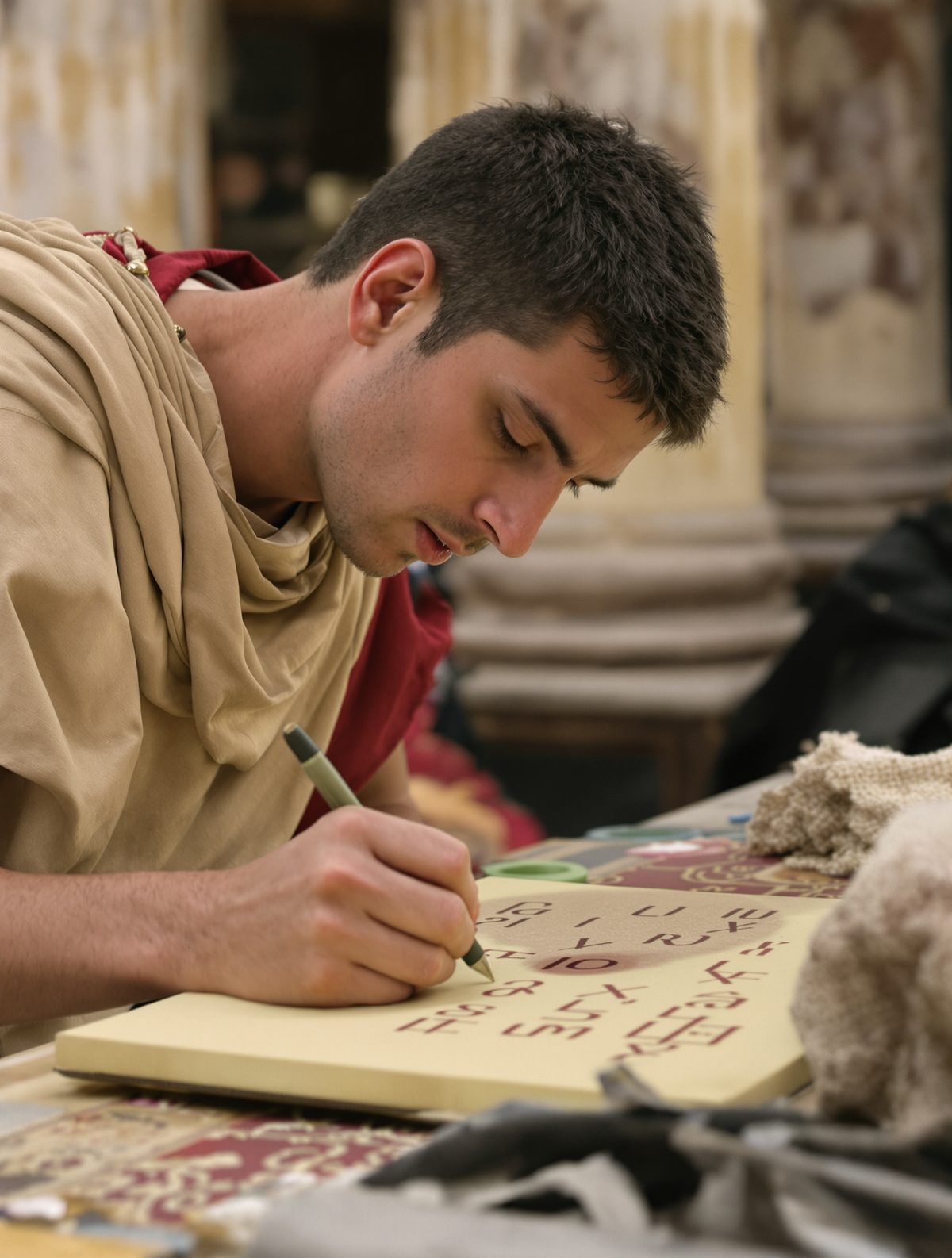
Picture this: A young prince stands in the shadow of the Great Pyramid, running his fingers along weathered limestone blocks that had already witnessed thirteen centuries of scorching desert winds. The year is 1250 BC, and to Prince Khaemwaset, son of the mighty Ramesses II, these towering monuments are as ancient as the Roman Colosseum is to us today. But unlike a casual tourist marveling at old stones, this royal heir is about to embark on history's first archaeological expedition—armed with chisels, scribes, and an obsession with preserving the past that would make modern museum curators weep with joy.
When New Kingdom Royalty Met the Old Kingdom's Ghosts
By 1250 BC, Egypt was experiencing what historians call the New Kingdom period—a golden age of power, wealth, and monumental construction under pharaohs like Ramesses II. Yet even in this era of unprecedented prosperity, the pyramids of Giza stood as mysterious relics from a civilization that felt impossibly distant. The Fourth Dynasty builders who erected these stone giants around 2580-2510 BC were separated from Khaemwaset by more time than separates us from the fall of Rome.
Khaemwaset wasn't just any prince. As the fourth son of Ramesses II and High Priest of Ptah in Memphis, he held one of the most prestigious religious positions in Egypt. His father had already begun his legendary 66-year reign, transforming Egypt into an empire that stretched from Nubia to the Levant. But while Ramesses II was busy carving his name on every available surface and building monuments to his own glory, his son was developing a very different obsession: honoring the dead kings of Egypt's distant past.
What drove this royal prince to spend decades crawling through crumbling temples and decaying pyramids? The answer lies in ancient Egyptian religious beliefs about ma'at—the cosmic order that required proper respect for ancestors and the preservation of divine kingship stretching back to the gods themselves.
The World's First Archaeological Survey
Around 1250 BC, Khaemwaset organized what can only be described as history's first systematic archaeological expedition. But this wasn't some dusty academic exercise—this was a massive royal undertaking involving teams of stonemasons, scribes, artists, and laborers. His mission: to restore and properly identify the crumbling monuments of Egypt's pyramid age.
The prince's work was desperately needed. By his time, many of the great pyramids and temples built during the Old Kingdom (roughly 2686-2181 BC) were in severe disrepair. Desert sand had buried entrances, limestone blocks had shifted and fallen, and most critically, the original inscriptions identifying the builders had been worn away by time or deliberately defaced by tomb robbers and later rulers seeking building materials.
Khaemwaset's teams didn't just slap some fresh mortar on cracked stones and call it a day. They conducted what we would recognize today as proper archaeological methodology. They carefully studied architectural styles, analyzed construction techniques, and—most remarkably—researched historical records to identify the original builders. When they found a pyramid or temple that had lost its identifying inscriptions, they didn't simply guess. They investigated.
The Restoration Tablets: Ancient Egypt's Historical Markers
Here's where Khaemwaset's work becomes truly extraordinary by ancient standards: he gave credit where credit was due. In an age when pharaohs routinely erased their predecessors' names and claimed their monuments, Khaemwaset did the opposite. He created what archaeologists call "restoration texts"—stone tablets that clearly identified the original builders while modestly noting his own conservation work.
One of his most famous restoration tablets, found at the pyramid complex of Pharaoh Unas at Saqqara, reads: "It was the High Priest of Ptah, Khaemwaset, who perpetuated the name of the King of Upper and Lower Egypt, Unas, since it was not found on the face of this pyramid, because the High Priest... Khaemwaset greatly loved to restore the monuments of the kings of Upper and Lower Egypt."
Think about how revolutionary this approach was. Khaemwaset lived in a world where pharaohs were considered living gods, where royal propaganda painted each ruler as the greatest who had ever lived. Yet here was a prince who spent his own resources and decades of his life ensuring that other kings—long-dead kings from a forgotten era—received proper recognition.
His restoration work extended far beyond the famous pyramids of Giza. Archaeological evidence shows he worked on monuments at Saqqara, Dahshur, and the Fayum region. He restored the pyramid of Pharaoh Sahure, the sun temple of Niuserre, and countless smaller temples and mastaba tombs that had been abandoned for over a millennium.
Detective Work in Ancient Egypt
Perhaps most fascinating is how Khaemwaset's teams solved the mystery of monuments whose original builders had been forgotten entirely. They became historical detectives, using architectural analysis and written records that are now lost to us. When they encountered a damaged pyramid or temple with no identifying inscriptions, they somehow managed to determine its original owner with remarkable accuracy—accuracy that has been confirmed by modern archaeological techniques.
Take the pyramid of Sahure at Abusir, built around 2487 BC. By Khaemwaset's time, nearly 1,200 years later, this monument was so deteriorated that its original identification had been lost. Yet Khaemwaset's restoration inscription correctly identifies Sahure as the builder. How did they know? They must have had access to administrative records, king lists, or oral traditions that have since vanished.
Even more impressive, Khaemwaset's teams didn't just restore individual monuments—they seem to have understood the broader historical context. Their work shows awareness of different architectural periods, construction techniques that had evolved over time, and the religious significance of specific design elements. They were practicing archaeology in ways that wouldn't become common in Europe until the 18th century AD.
The Prince Who Never Became Pharaoh
Ironically, the man who devoted his life to preserving royal memory never became pharaoh himself. Despite being clearly favored by his father—Ramesses II appointed him High Priest of Ptah, one of Egypt's most important religious positions—Khaemwaset died around 1225 BC, predeceasing his famously long-lived father by about 12 years.
His death was mourned throughout Egypt. Inscriptions describe him as "beloved of the gods" and praise his piety, wisdom, and dedication to preserving Egypt's sacred monuments. He was buried with honors typically reserved for pharaohs, in a magnificent tomb in the Valley of the Kings that reflected his status as both royal prince and High Priest.
But here's a delicious historical irony: while Khaemwaset spent his life ensuring that forgotten pharaohs would be remembered, his own remarkable achievements were largely forgotten by later generations. Classical historians like Herodotus and Diodorus, writing about ancient Egypt centuries later, make no mention of him. It wasn't until modern archaeologists began studying his restoration inscriptions that we realized what he had accomplished.
Legacy Written in Stone
Today, as we stand before the pyramids of Giza or walk through the ruins of Saqqara, we're seeing monuments that exist partly because of Prince Khaemwaset's vision 3,300 years ago. Without his intervention, many of these structures might have crumbled beyond recognition long before modern archaeology could study them. His restoration work literally preserved Egyptian history for future generations to rediscover.
But Khaemwaset's true legacy goes deeper than the stones he repaired. He established a principle that seems obvious to us but was revolutionary in the ancient world: that the past belongs to everyone, not just the powerful. In an age of absolute monarchy and divine kingship, he insisted that even forgotten pharaohs deserved respect and remembrance.
Perhaps most remarkably, he understood something that many modern nations still struggle with—that preserving history isn't about glorifying yourself, but about maintaining the continuity of human knowledge and culture. Every time we visit a museum, restore a historic building, or fight to preserve an archaeological site, we're following in the footsteps of a New Kingdom prince who believed that memory itself was sacred.
In our age of rapid change and digital amnesia, Khaemwaset's dedication to preserving the past feels more relevant than ever. He reminds us that being truly civilized means not just creating great things, but ensuring they survive for those who come after us.