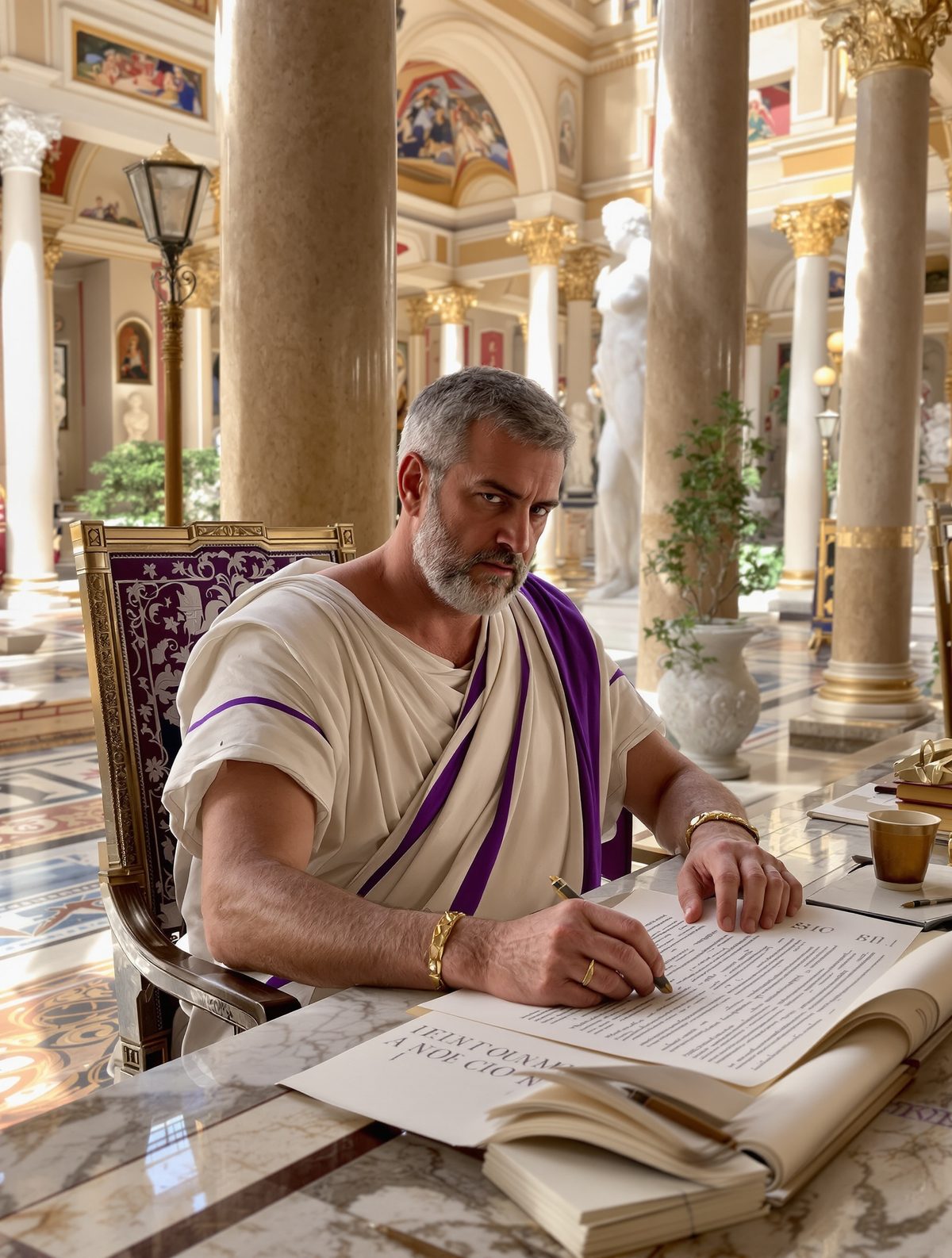
Picture this: you're dead, but you don't know it yet. You wake up in your palace bed, summon your servants, and begin implementing the most popular reforms in Persian history. Meanwhile, the man who murdered you—your own brother—watches in horror from hundreds of miles away as reports flood in of your miraculous "return." Welcome to one of history's most audacious cases of identity theft, set in an empire that spanned three continents and involved a conspiracy that nearly toppled the greatest dynasty the ancient world had ever seen.
In 522 BC, as spring bloomed across the vast Persian Empire, something impossible happened. Prince Bardiya, son of the great Cyrus the Great, emerged from months of mysterious absence to claim his throne and revolutionize his realm. The people rejoiced. Taxes vanished. Slaves walked free. It seemed too good to be true.
It was.
The Brother's Bloody Secret
To understand this extraordinary deception, we must first meet the players in this deadly family drama. Cambyses II, the reigning Persian King of Kings, was not what you'd call a stable ruler. While conquering Egypt in 525 BC, paranoia consumed him like a fever. He saw enemies everywhere—in his court, in his dreams, and most dangerously, in his own family.
His younger brother Bardiya posed a particular problem. Handsome, charismatic, and beloved by the people, Bardiya represented everything Cambyses feared he was not. Ancient sources describe Bardiya as possessing the kind of natural leadership that made men want to follow him into battle and women swoon at royal gatherings. More troubling still, Bardiya had a legitimate claim to the throne.
So Cambyses did what any loving brother would do: he had Bardiya secretly murdered.
The assassination, carried out sometime in 525 BC, was a masterpiece of royal discretion. No public execution, no grand announcements—Bardiya simply disappeared. Officially, the prince had been sent on administrative duties to the far eastern provinces. Unofficially, his body lay buried in an unmarked grave, known only to Cambyses and his most trusted executioner.
For nearly two years, this dark secret festered in Cambyses's mind as he continued his Egyptian campaigns, growing more erratic and cruel with each passing month. Little did he know that his perfect crime was about to become his perfect nightmare.
Enter the Impostor
While Cambyses waged war abroad, back in Persia, a Magus named Gaumata was hatching the most ambitious identity theft in ancient history. The Magi were Persia's priestly caste—learned men who understood both the mysteries of Zoroastrian religion and the intricate workings of palace politics. Gaumata possessed something even more valuable: an uncanny physical resemblance to the dead prince Bardiya.
But resemblance alone wouldn't be enough to fool an empire. Gaumata had clearly done his homework. He knew Bardiya's mannerisms, his speech patterns, his personal relationships. More crucially, he understood what the Persian people desperately wanted to hear after years of Cambyses's increasingly oppressive rule.
In March 522 BC, the impossible happened. "Bardiya" appeared at the royal palace in Pasargadae, claiming his rightful place as king. The timing was perfect—Cambyses was still fighting in Egypt, thousands of miles away, and communication across the empire moved at the speed of horseback.
What happened next reveals just how brilliant Gaumata's strategy really was. Rather than simply claiming power, he launched the most popular reform program in Persian history. The Behistun Inscription, carved into a cliff face in western Iran, records his revolutionary policies: he abolished taxes for three years, freed slaves, and returned confiscated properties to their original owners.
Imagine the scene across the empire as these decrees were read aloud in marketplaces and town squares. After years of grinding taxation to fund Cambyses's wars, suddenly the people could keep their grain, their gold, their sons. Slaves who had labored in mines and fields for decades walked free. It was as if a benevolent god had descended to rule Persia.
The Empire's Golden Moment
For seven months, Gaumata's masquerade created what might have been the happiest period in early Persian history. The Nabonidus Chronicle, a Babylonian record, notes that tribute from the provinces actually increased during this period—not because taxes rose, but because grateful populations voluntarily sent gifts to their beloved king.
Gaumata proved remarkably adept at royal duties. He held court, settled disputes, and managed the complex administration of an empire stretching from India to Greece. Persian nobles who had known the real Bardiya seemed convinced by his performance. If they harbored any doubts, the popularity of his reforms likely silenced their concerns.
The false Bardiya even took wives as a king should, including, scandalously, some who had been married to the real Bardiya. In the closed world of Persian royalty, where kings routinely married their sisters and daughters to preserve bloodlines, this move both legitimized his claim and eliminated potential witnesses to his deception.
Meanwhile, hundreds of miles away in Egypt, the real king Cambyses received increasingly disturbing reports. His dead brother was alive, ruling his empire, and beloved by his people. The psychological impact must have been devastating. Ancient sources describe Cambyses falling into a rage so complete that he accidentally stabbed himself while mounting his horse.
Whether by divine justice, psychological breakdown, or simple accident, Cambyses died from this wound in July 522 BC, taking the secret of Bardiya's murder with him to his grave. For a brief moment, it seemed Gaumata had achieved the impossible—he had stolen an empire and might keep it forever.
The Conspiracy Unravels
But empires aren't built by men who give up easily. Among the Persian nobility, a young man named Darius—distantly related to the royal family—began asking uncomfortable questions. Why had "Bardiya" become so reclusive, rarely appearing in public? Why did he conduct most business through intermediaries? And why, whispered the palace servants, did the king now sleep with his head covered?
That last detail would prove fatal to Gaumata's deception. According to Herodotus, the real Bardiya had once had his ears cut off as punishment for some transgression—a detail known only to Cambyses's inner circle. If the current "Bardiya" was missing his ears, it would prove he was genuine. If not...
Darius assembled a conspiracy of six other Persian nobles—men whose names would echo through history: Intaphernes, Megabyzus, Aspathines, Gobryas, Hydarnes, and Otanes. Together, these Seven Conspirators planned what amounted to the world's first forensic investigation.
On September 29, 522 BC, they struck. Forcing their way into the royal apartments, they confronted Gaumata directly. In the struggle that followed—described in vivid detail on the Behistun Inscription—the truth literally came to light. The man who had ruled the Persian Empire for seven months, who had freed slaves and abolished taxes, who had convinced an entire empire he was their beloved prince, was revealed to be exactly what he appeared: a Magus with intact ears and royal blood on his hands.
Gaumata died fighting, sword in hand, still maintaining his desperate masquerade to the end.
Legacy of the Great Deception
Darius, as the leader of the conspiracy, claimed the throne and became Darius the Great—one of history's most successful rulers. But he never forgot how close the empire had come to being ruled by an impostor. The Behistun Inscription, which he commissioned, stands as both a monument to his victory and a warning about the power of deception.
Yet Gaumata's story raises uncomfortable questions that echo across the centuries. His reign, though built on lies, brought genuine relief to millions of people. His policies were more popular than those of the "legitimate" kings who preceded and followed him. In an age when divine right justified royal rule, what made his claim less valid than that of Darius, who won his crown through violence rather than birth?
The Persian Empire survived Gaumata's deception and flourished under Darius, eventually becoming the largest empire the ancient world had ever seen. But for seven months in 522 BC, it was ruled by perhaps history's most successful con man—a priest who understood that sometimes the best way to steal a kingdom is to give the people exactly what they want.
In our modern age of deepfakes, identity theft, and political theater, Gaumata's story serves as a reminder that the line between authentic and artificial has always been thinner than we'd like to believe. Sometimes the fake king governs better than the real one—and sometimes the greatest truth emerges from the most audacious lie. The question that haunted ancient Persia haunts us still: in a world where appearance can be manufactured and identity can be stolen, how do we know who we're really following?