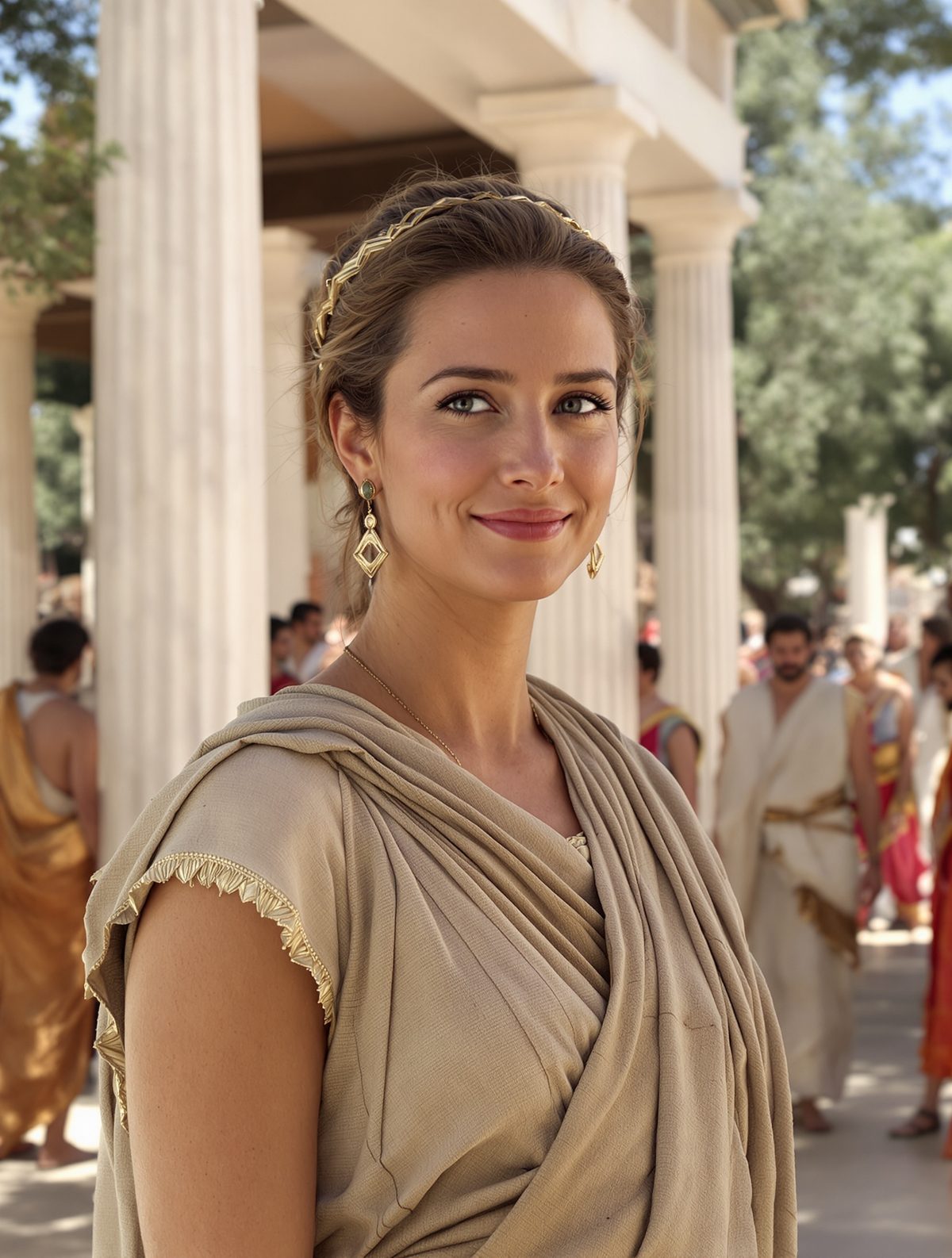
Picture this: It's high noon in the bustling Egyptian city of Syene, around 240 BC. The Mediterranean sun beats down mercilessly on limestone buildings and palm-lined streets. But something extraordinary is happening—or rather, not happening. Look down into the city's wells, and you'll see something impossible: the water at the bottom perfectly reflects the sky above. No shadows. No darkness. The sun's rays plunge straight down like golden spears, illuminating depths that should be shrouded in gloom.
Meanwhile, 500 miles north in the great city of Alexandria, that same sun casts sharp, definitive shadows. Columns throw dark lines across marble courtyards. Obelisks become sundials. And in the Great Library—the intellectual heart of the ancient world—a brilliant mind is about to turn this curious difference into one of humanity's greatest mathematical achievements.
His name was Eratosthenes, and he was about to measure the entire planet using nothing more than shadows, geometry, and pure human ingenuity.
The Librarian Who Saw the World Differently
Eratosthenes of Cyrene wasn't your typical ancient scholar. Born around 276 BC in what is now Libya, he was that rare intellectual who refused to be confined to a single discipline. His contemporaries called him "Pentathlos"—after the five-event Olympic competition—because he excelled in so many fields: mathematics, astronomy, geography, poetry, and philosophy. Some meant it as a compliment; others, less kindly, suggested he was a jack-of-all-trades, master of none.
History would prove the critics spectacularly wrong.
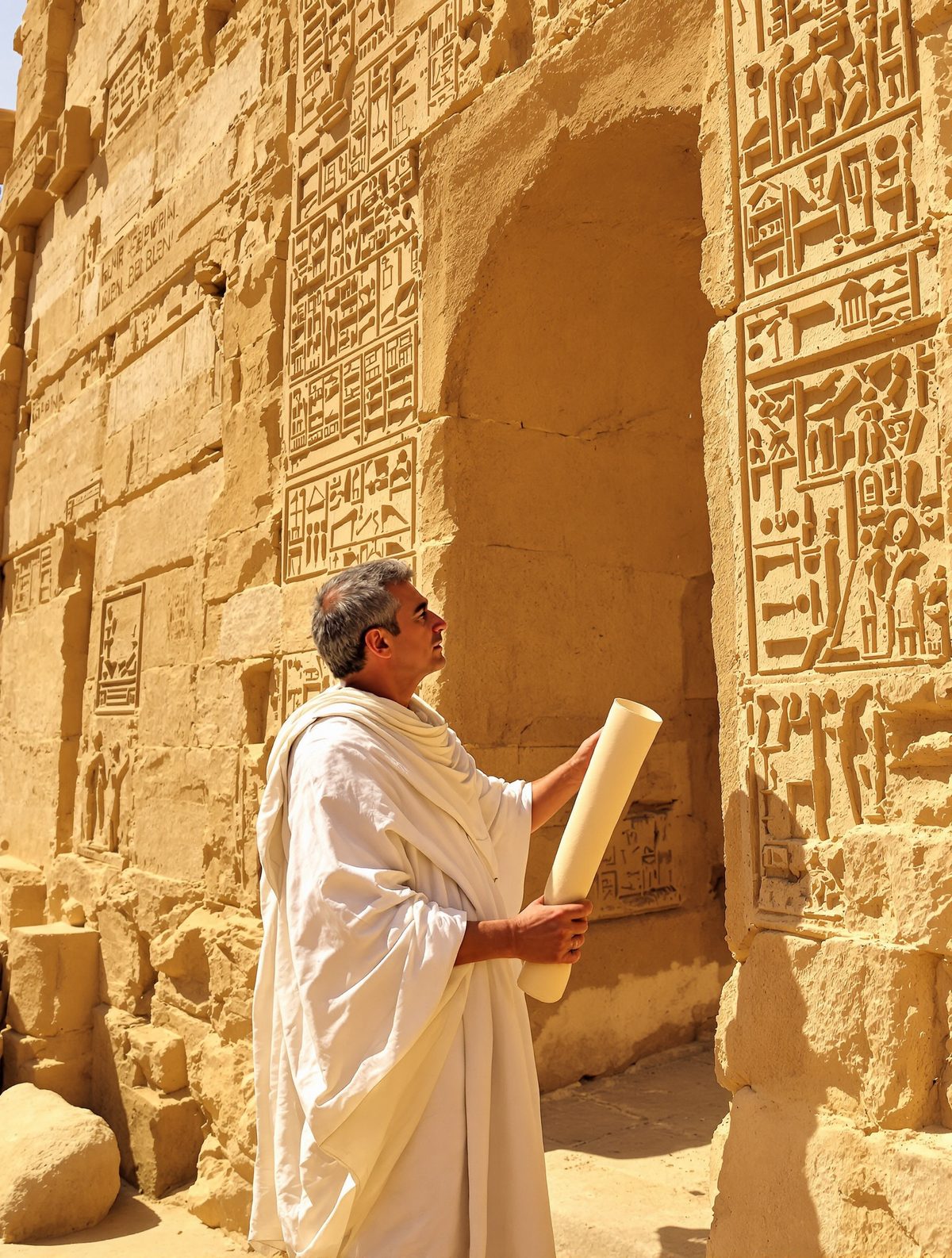
By 240 BC, Eratosthenes had secured the most prestigious academic position in the ancient world: Chief Librarian of the Great Library of Alexandria. This wasn't just any library—it was humanity's first attempt at collecting all knowledge under one roof. With somewhere between 400,000 and 700,000 scrolls, it housed everything from Homer's epics to cutting-edge mathematical treatises. Ships entering Alexandria's harbor were required to surrender any books for copying. Scholars traveled from across the Mediterranean to study there.
And at its heart sat Eratosthenes, surrounded by the accumulated wisdom of civilizations, about to add his own revolutionary chapter.
The Mystery of the Shadowless Well
The story begins with an observation that most people would have dismissed as a curious local quirk. In Syene (modern-day Aswan), there was a famous well that, once a year, would reflect the sun perfectly at noon. Local residents had known about this phenomenon for generations—on the summer solstice, June 21st, you could see the sun's reflection dancing on the water far below, unobstructed by any shadows from the well's walls.
What made this remarkable wasn't just the pretty sight—it meant the sun was positioned directly overhead, its rays falling perfectly perpendicular to the Earth's surface. Syene sat precisely on the Tropic of Cancer, though the ancient Egyptians didn't have that terminology yet. They just knew that once a year, the sun god Ra looked straight down their wells.
But here's where Eratosthenes's genius kicked in: he realized that this never happened in Alexandria. No matter what day of the year, no matter what time, vertical objects in Alexandria always cast shadows. Even at high noon on the summer solstice, when the sun was at its highest point, obelisks and columns still threw short but definite shadows northward.
Most people would have shrugged and attributed this to the whims of the gods. Eratosthenes saw something far more profound: proof that the Earth was curved.
A Geometric Revelation
Now came the stroke of brilliance that would echo through history. Eratosthenes understood that if the Earth were flat, the sun's rays would hit both cities at exactly the same angle. The fact that they didn't could mean only one thing: the planet was spherical, and the two cities sat at different positions on that sphere.
On the summer solstice of 240 BC, as the sun reached its zenith over Syene's shadowless wells, Eratosthenes was in Alexandria, carefully measuring the shadow cast by a vertical stake. The shadow formed an angle of approximately 7.2 degrees—or about one-fiftieth of a full circle (360 degrees).
Here's where the math gets beautiful in its simplicity. If Alexandria and Syene were separated by 1/50th of the Earth's circumference in terms of the sun's angle, then the distance between them—roughly 5,000 stadia in ancient measurements—must represent 1/50th of the Earth's total circumference.
The calculation was elegantly straightforward: 5,000 stadia × 50 = 250,000 stadia for the Earth's full circumference.
Converting ancient measurements to modern ones is tricky because different regions used different stadium lengths, but most scholars believe Eratosthenes was using the Egyptian stadium of about 157.5 meters. This would give him a circumference of roughly 39,375 kilometers—compared to the actual equatorial circumference of 40,075 kilometers. His error? Less than 2%.
Using sticks, shadows, and basic geometry, a man in ancient Egypt had measured the entire planet to within a few hundred miles.
The Man They Called "Beta"
Despite this incredible achievement, Eratosthenes faced criticism from his scholarly peers. Some contemporaries dubbed him "Beta"—the second letter of the Greek alphabet—suggesting he was always second-best in every field he touched. They saw his broad interests as a weakness, preferring specialists who devoted their entire lives to mastering single disciplines.
But Eratosthenes's interdisciplinary approach was precisely what made his breakthrough possible. A pure mathematician might not have cared about geographical phenomena. A geographer might not have possessed the geometric skills to make the calculation. A astronomer might not have had access to the travel reports that gave him the distance between the two cities.
Eratosthenes was also remarkably practical in his methods. He didn't just rely on the shadowless well—he confirmed his measurements using other techniques and locations. He created improved maps, calculated the tilt of Earth's axis (with remarkable accuracy), and even estimated the distance to the sun and moon.
Perhaps most impressively, he did all this without any of the tools we'd consider essential today. No telescopes. No precise chronometers. No satellite imagery. Just careful observation, logical reasoning, and mathematical insight.
The Knowledge That Was Almost Lost
Here's a fact that might surprise you: Eratosthenes's achievement was largely forgotten in medieval Europe, not because it was wrong, but because the knowledge was lost along with much of classical learning. By the time Christopher Columbus set sail in 1492, European scholars were working with much less accurate estimates of Earth's size—which is partly why Columbus thought he could reach Asia by sailing west.
Ironically, if Columbus had access to Eratosthenes's more accurate calculations, he might never have attempted his voyage, believing the distance to Asia was impossibly far. The "discovery" of America happened partly because later scholars were less accurate than their ancient predecessors.
Meanwhile, in the Islamic world, scholars not only preserved Eratosthenes's work but improved upon it. In 9th-century Baghdad, the Abbasid Caliph Al-Ma'mun commissioned expeditions to re-measure Earth's circumference, achieving results that closely matched the Greek librarian's calculations from over a millennium earlier.
Eratosthenes himself lived to see his reputation grow. He remained Chief Librarian until his death around 194 BC, when he was roughly 82 years old. Legend has it that he died by voluntary starvation after going blind, unable to bear life without his beloved books and observations. Even in death, he embodied the passionate pursuit of knowledge that defined his extraordinary life.
Why Ancient Shadows Still Matter Today
In our age of GPS satellites and laser measurements, it's easy to dismiss Eratosthenes's achievement as merely historical curiosity. But his story offers something more profound: a reminder of what human ingenuity can accomplish with careful observation and logical thinking.
Consider what he actually did. Using tools available to any reasonably educated person of his time, Eratosthenes proved that individual human beings could unlock the secrets of the cosmos. He demonstrated that the universe operates according to rational, measurable principles—laying crucial groundwork for the scientific revolution that would transform our world centuries later.
Perhaps most importantly, he showed that the biggest discoveries often come from asking the right questions about phenomena that everyone else takes for granted. Why do shadows fall differently in different places? It's the kind of question a child might ask, and that most adults would dismiss.
But sometimes, the most profound truths hide behind the simplest observations. All it takes is someone willing to notice that shadows don't always behave the way we expect them to—and brilliant enough to figure out what that really means.
In an era when information travels at the speed of light and artificial intelligence can process vast datasets in milliseconds, there's something deeply moving about a man using shadows and geometry to measure the world. Eratosthenes reminds us that the most important tool in science isn't technology—it's curiosity, combined with the courage to follow that curiosity wherever it leads, even if the journey takes you around the entire planet.