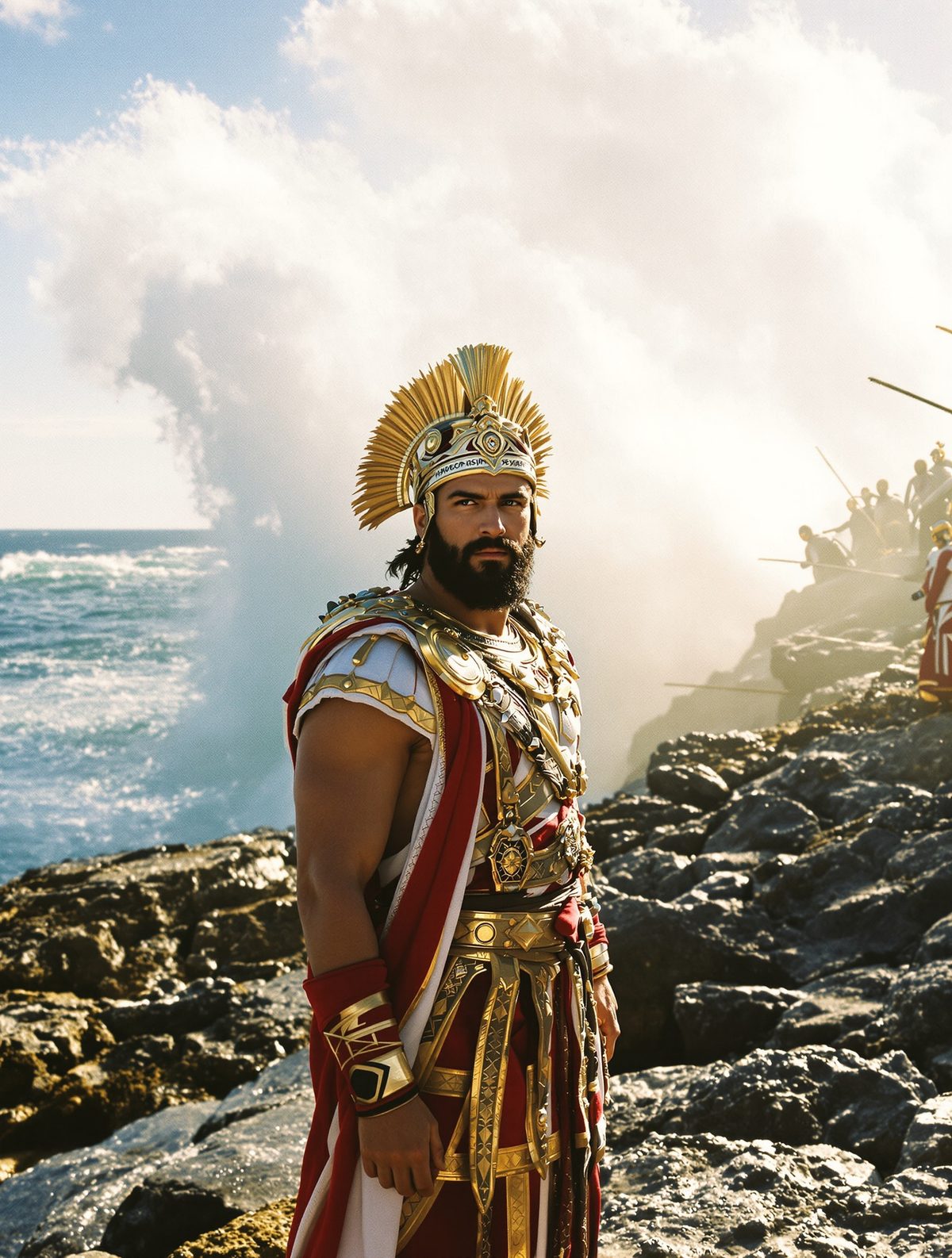
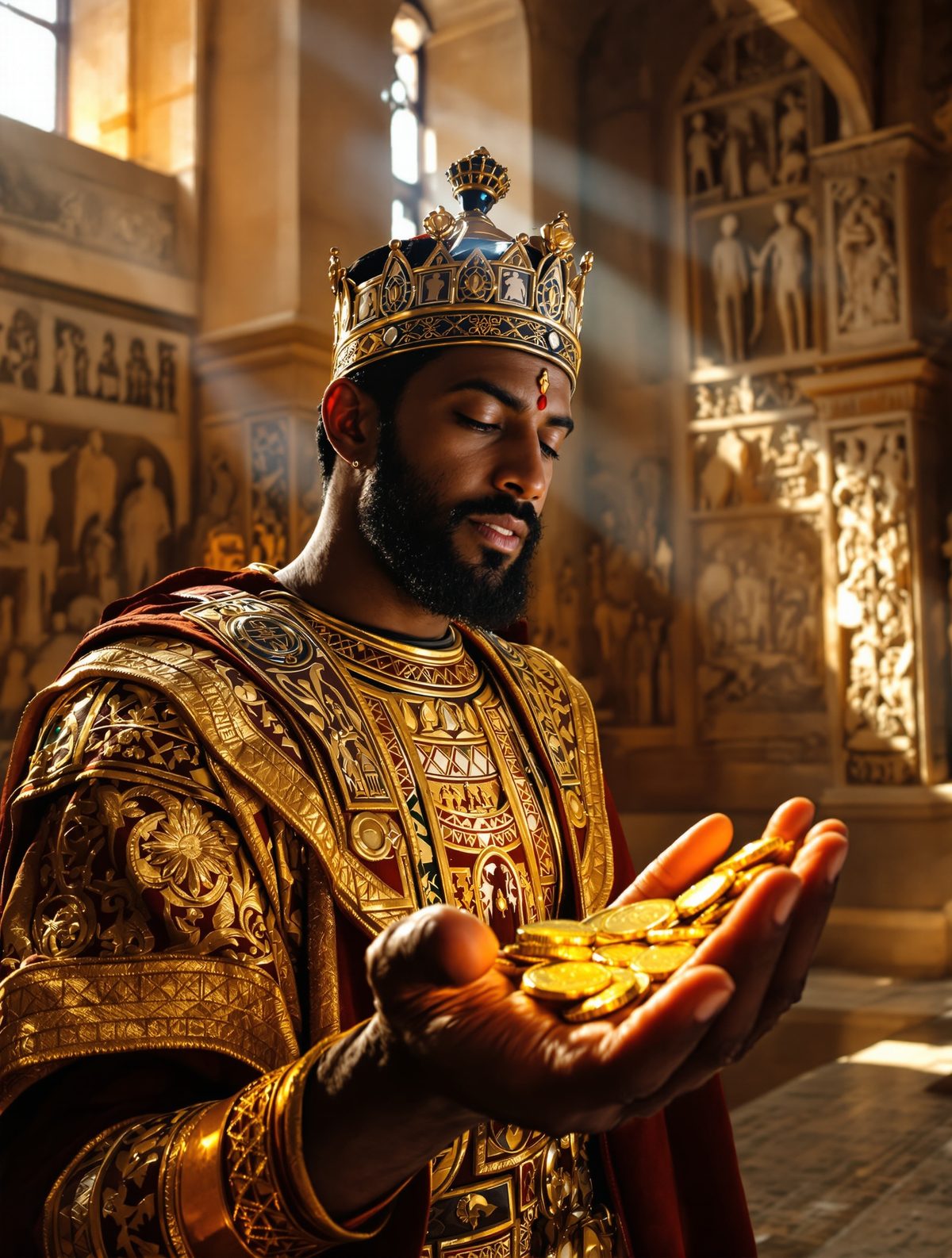
In the spring of 522 BC, the most powerful man on Earth prepared to mount his horse on a dusty road in Syria. Cambyses II ruled an empire that stretched from the sun-baked valleys of Ethiopia to the spice markets of India—half the known world bowed before his throne. He had crushed Egypt's ancient pharaohs, plundered their temples, and made himself master of the Nile. Yet in one careless moment, as he swung his leg over his stallion's back, destiny would play the cruelest of tricks.
His sword—the very blade that had carved out the greatest empire the world had ever seen—slipped from its bronze scabbard like a serpent striking in the dark. The razor-sharp iron found its mark with surgical precision, piercing deep into the king's thigh. As crimson blood soaked through his royal robes, Cambyses stared at the wound in horror. The blade had struck the exact same spot where, months earlier, he had plunged a dagger into the sacred Apis bull of Memphis.
The priests' curse, it seemed, had finally come home.
The Son of Cyrus: Born to Conquer
Cambyses II wasn't just any Persian nobleman—he was the son of Cyrus the Great, the legendary king who had forged the Persian Empire from nothing more than a collection of warring tribes. When Cyrus died in 530 BC, fighting nomads on the empire's distant frontier, his eldest son inherited a realm that already dwarfed anything history had witnessed. But for Cambyses, this wasn't enough.
The young king's obsession lay to the west, across the burning sands that separated Persia from Egypt. The land of the pharaohs had stood unconquered for three millennia, its ancient gods and golden treasures calling to him like a siren song. Egypt wasn't just wealthy—it was symbolic. Whoever ruled the Nile ruled the cradle of civilization itself.
In 525 BC, Cambyses launched his invasion with characteristic Persian efficiency. His army was a multicultural war machine: 10,000 elite Persian Immortals marched alongside Median cavalry, Babylonian siege engineers, and Arabian camel corps. But Cambyses' secret weapon wasn't military—it was psychological warfare that would have made Machiavelli proud.
The Conquest That Broke a Civilization
The Battle of Pelusium in 525 BC became one of history's most bizarre military encounters. Knowing that Egyptians considered cats sacred to the goddess Bastet, Cambyses ordered his soldiers to paint images of Egyptian gods on their shields and drive hundreds of cats, ibises, and other sacred animals before their advancing ranks. The Egyptian pharaoh Psamtik III faced an impossible choice: slaughter the holy creatures to reach his enemies, or watch his kingdom fall.
The Egyptians couldn't bring themselves to harm the sacred animals. Their arrows remained in their quivers as Persian spears found their marks. In a single day, a civilization that had built the pyramids and mapped the stars crumbled before a few hundred terrified cats.
Psamtik III was dragged before Cambyses in chains, and the Persian king didn't just claim Egypt's throne—he proclaimed himself pharaoh, complete with all the divine trappings that came with it. For the first time in 3,000 years, Egypt bowed to foreign rule. The Persian Empire now stretched across 2 million square miles and commanded the loyalty of perhaps 50 million subjects.
But Cambyses' hunger for conquest had only grown stronger. He immediately began planning even more audacious campaigns: one army would march south to conquer Nubia and Ethiopia, while another would strike west against the oracle of Ammon in the Libyan desert. A third force would sail around Africa to attack Carthage. The man who already ruled half the world wanted it all.
The Sacred Bull and the King's Rage
While Cambyses dreamed of endless conquest, trouble was brewing in his Egyptian capital of Memphis. The Apis bull—a living god to the Egyptians—had died, and the priests were preparing the elaborate funeral rites that had been performed for over 1,000 years. To the Egyptians, this was a sacred duty. To Cambyses, it looked like rebellion.
The Persian king had grown increasingly paranoid during his Egyptian sojourn. His brother Bardiya (called Smerdis by the Greeks) had remained in Persia as regent, and Cambyses suspected him of plotting treason. His ambitious campaigns in Nubia had ended in disaster when his army ran out of supplies in the desert, and 50,000 soldiers sent to destroy the oracle of Ammon had simply vanished into the sand, never to be seen again.
When Cambyses discovered the Egyptians mourning their sacred bull, his rage exploded. How dare his subjects grieve when he was suffering military setbacks? In a fit of fury that would define his legacy, he ordered the dead bull brought before him. Then, in full view of the horrified priests, he drew his dagger and plunged it into the animal's thigh.
"If this is your god," he reportedly sneered, "let him heal himself."
The Egyptian priests recoiled in horror. They had witnessed the ultimate sacrilege—the desecration of a living god by a foreign tyrant. As they carried away the bull's corpse, their whispered curses followed Cambyses like shadows. The god Apis would have his revenge, they promised. The king would die by the same wound he had inflicted.
The Rebellion That Shook an Empire
In March 522 BC, devastating news reached Cambyses in Memphis. A man claiming to be his brother Bardiya had seized the Persian throne and was rallying the empire's subjects against their absent king. Whether this was the real Bardiya or an impostor named Gaumata (as later Persian propaganda claimed) remains one of history's great mysteries. What mattered was that half of Cambyses' empire had risen in revolt.
The timing couldn't have been worse. Cambyses was trapped in Egypt with most of his army, while the pretender controlled Persia's heartland and its vast treasury. Provinces from Media to Bactria were declaring independence, and the greatest empire in history was fracturing like a clay pot dropped from a great height.
Cambyses had no choice but to abandon Egypt and march back to reclaim his throne. He loaded his most loyal troops onto ships and began the long journey through Palestine toward Persia. Every day of delay meant more provinces lost, more treasures seized, more legitimacy transferred to his rival. The king who had conquered half the world was racing against time to save what remained of his empire.
As the Persian column approached the Syrian city of Ecbatana (modern-day Hamadan), Cambyses prepared to address his troops. These men had followed him across deserts and through enemy lines—they deserved to hear their king's plan for victory. He would rally them with words of Persian valor and promises of glorious revenge.
The Moment That Changed History
What happened next took perhaps three seconds, but those seconds would reshape the ancient world. As Cambyses vaulted onto his war horse—a movement he had performed thousands of times—his bronze scabbard caught on the saddle. The sword, its blade honed to perfection by Persian metalworkers, slipped free like quicksilver.
The point found his right thigh with the precision of an executioner's axe. Iron pierced flesh, muscle, and possibly bone before the king's weight drove the blade deeper. Blood immediately began flowing through his robes as Cambyses stared down at the wound in shock and growing horror.
The injury was in the exact spot where he had stabbed the sacred Apis bull.
His Persian bodyguards rushed to help their wounded king, but Cambyses must have understood the terrible symbolism immediately. He had mocked the Egyptian gods, and now he was paying the price in his own blood. The priests' curse had traveled 800 miles and waited months for its moment of revenge.
For three agonizing weeks, the most powerful man on Earth lay dying in a Syrian tent while his empire crumbled around him. The wound festered and turned gangrenous in the desert heat. Persian physicians, trained in the most advanced medicine of their age, could do nothing but watch as infection consumed their king's leg and then his life.
In July 522 BC, Cambyses II died in agony, cursing the gods of Egypt with his final breath. He was perhaps 45 years old and had ruled for less than eight years. His body was hastily mummified and sent back to Persia, while his surviving nobles began the desperate scramble to hold together an empire without an emperor.
The Throne That Nearly Vanished
Cambyses' bizarre death triggered the greatest succession crisis in ancient history. For months, the Persian Empire teetered on the edge of complete collapse as rival claimants fought for the throne while provinces declared independence across the known world. It took the political genius of Darius I—a distant cousin who seized power through a combination of military skill and propaganda brilliance—to restore Persian rule.
But the empire Darius inherited was forever changed. The aura of invincibility that had surrounded Persian kings since Cyrus the Great was broken. Subject peoples had learned that the Persians could be challenged, that their empire could fracture, that their kings could die just as easily as any mortal man.
Perhaps most importantly, Cambyses' death demonstrated the dangerous intersection of religious sensitivity and political power. His casual desecration of Egyptian beliefs had turned a conquered population into implacable enemies. The priests who cursed him became symbols of resistance that would inspire rebellions for generations to come.
The story of Cambyses II reminds us that even in our interconnected modern world, the consequences of cultural insensitivity can be profound and lasting. Leaders who dismiss the deeply held beliefs of others—whether religious, cultural, or political—do so at their own peril. Sometimes the sword we draw against others' sacred traditions is the same blade that ultimately cuts us down.
In the end, the king who conquered half the world was defeated by three seconds of carelessness and the long memory of those he had wronged. History has a way of keeping score, even when we think we've won the game.