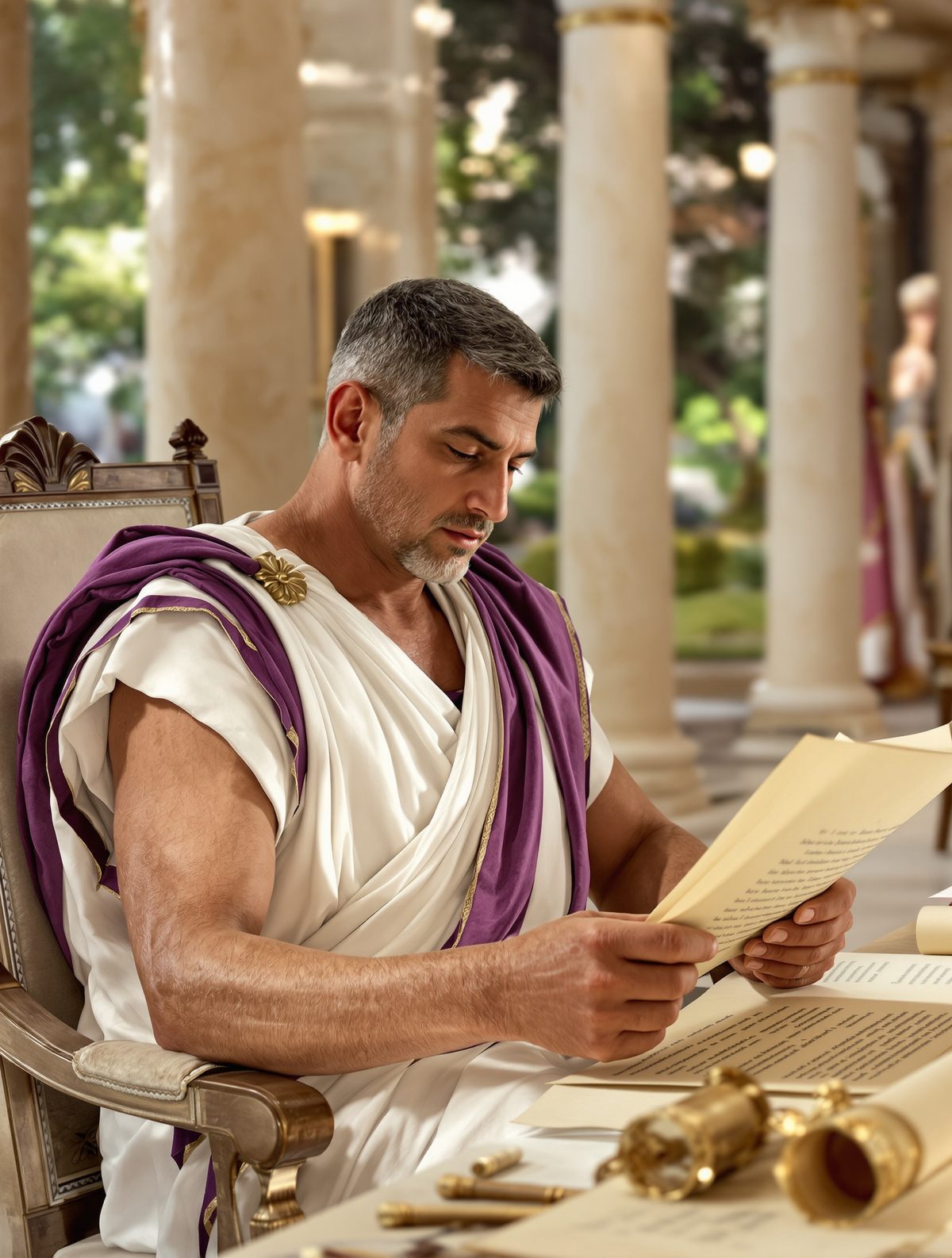
Picture this: In the flickering lamplight of his palace at Nineveh, a man sits hunched over clay tablets, carefully reading ancient Sumerian poetry. His hands, still stained with blood from the day's executions, delicately trace cuneiform symbols that speak of love, loss, and the meaning of existence. This isn't some gentle scholar—this is Ashurbanipal, King of Assyria, a man who once boasted that he made enemy kings pull his chariot like dogs while wearing leashes around their necks. Yet here he is, at the peak of his brutal reign, obsessively collecting every piece of written knowledge he can find.
Welcome to one of history's most fascinating contradictions: the warrior king who built the world's first great library while simultaneously perfecting the art of psychological warfare.
The Blood-Soaked Scholar
When Ashurbanipal ascended to the throne of Assyria in 668 BC, he inherited an empire that stretched from Iran to Egypt—the largest the world had ever seen. The Assyrians had built this vast domain through sheer brutality, and Ashurbanipal proved himself their most creative practitioner of terror. His royal inscriptions read like horror novels: enemies flayed alive, their skin used to cover palace walls; captured kings forced to live in dog kennels; entire cities burned to ash with their populations enslaved.
But between these campaigns of calculated cruelty, Ashurbanipal did something unprecedented. He sent scribes across his empire with a simple mission: copy every text you can find and bring it back to Nineveh. Not just Assyrian texts—everything. Babylonian epics, Egyptian medical treatises, Hittite historical chronicles, Persian astronomical observations. If it was written down, Ashurbanipal wanted it.
This wasn't mere intellectual curiosity. For Ashurbanipal, knowledge was power in the most literal sense. He believed that by possessing the written wisdom of conquered peoples, he was literally stealing their cultural soul. It was psychological warfare elevated to an art form.
The Greatest Library Heist in History
What Ashurbanipal orchestrated between 650-630 BC was essentially the ancient world's greatest intellectual theft. His agents didn't just copy texts—they systematically looted libraries from Babylon to Memphis. When the great temple libraries of southern Mesopotamia tried to hide their most precious manuscripts, Ashurbanipal's scholars arrived with detailed lists of what they wanted, demanding everything from the Epic of Gilgamesh to obscure divination manuals used by local priests.
The scale was breathtaking. His library at Nineveh eventually contained over 30,000 cuneiform tablets—more books than would exist in any single location again until the Great Library of Alexandria centuries later. But while Alexandria's collection would be built through scholarly collaboration, Ashurbanipal's was assembled through conquest and cultural appropriation on an industrial scale.
The irony wasn't lost on contemporary observers. Here was a king who destroyed the ancient city of Babylon in 648 BC, yet spent enormous resources preserving Babylonian literature. He burned Thebes to the ground in 663 BC while simultaneously commissioning Egyptian scribes to translate their medical papyri into cuneiform.
The King Who Could Actually Read His Collection
Here's what makes Ashurbanipal truly extraordinary: unlike most ancient rulers who collected texts as symbols of power, he could actually read them. Fluently. In multiple languages.
Ashurbanipal bragged about his education in terms that would make any modern scholar jealous. He claimed mastery of Sumerian and Akkadian literature, could read ancient scripts that even contemporary priests struggled with, and understood complex mathematical and astronomical texts. Royal inscriptions show him boasting: "I have read intricate tablets inscribed with obscure Sumerian, difficult to master, and Akkadian, which is hard to use correctly. I have examined stone inscriptions from before the flood."
This wasn't royal propaganda—surviving tablets from his library are covered with his personal annotations. Marginal notes in his handwriting show him cross-referencing different versions of the same story, correcting scribal errors, and even adding his own commentary on historical events. Imagine finding Hitler's personal notes on philosophy texts, or Stalin's margin comments in poetry collections. It's that jarring.
A Collection Beyond Imagination
Walking through Ashurbanipal's library would have been like entering the mind of a civilization. The collection was organized with sophisticated cataloging systems that wouldn't be matched until the modern era. Tablets were grouped by subject: literature, history, medicine, astronomy, mathematics, law, and religion. Each section was subdivided further—medical texts separated into surgery, pharmacy, and diagnostic manuals; literary works arranged by period and style.
The diversity was staggering. Alongside the famous Epic of Gilgamesh (the most complete version we have comes from Ashurbanipal's library) sat practical manuals on everything from veterinary medicine to glassmaking. There were dictionaries in multiple languages, astronomical charts predicting eclipses decades in advance, and historical chronicles stretching back over a thousand years.
But perhaps most remarkably, Ashurbanipal insisted on collecting multiple versions of the same texts. His library contained seven different versions of the Babylonian creation myth, twelve variants of flood stories, and dozens of copies of major literary works from different regions. He was essentially creating the ancient world's first comparative literature collection.
The Paradox of Preservation Through Destruction
The ultimate irony of Ashurbanipal's legacy became clear in 612 BC, just fifty years after his death. When a coalition of Babylonians and Medes sacked Nineveh, they destroyed the Assyrian Empire so thoroughly that the city disappeared from history for over 2,000 years. The great palace was burned, the walls torn down, and the population scattered.
But in destroying the palace, the fires that consumed Nineveh accidentally baked Ashurbanipal's clay tablets to ceramic hardness, preserving them for millennia. The same flames that ended Assyrian power ensured that their king's collection would survive when papyrus scrolls and parchment books crumbled to dust.
When British archaeologist Austen Henry Layard uncovered the library ruins in the 1850s, he found humanity's oldest surviving collection of literature perfectly preserved in the rubble. Texts that had been lost for millennia suddenly reappeared: the complete Epic of Gilgamesh, the Enuma Elish creation story, mathematical treatises that wouldn't be equaled until Islamic scholars of the medieval period.
The Brutal Curator's Lasting Gift
Today, Ashurbanipal's collection forms the cornerstone of our understanding of ancient Mesopotamian civilization. Nearly every major literary work we possess from ancient Iraq comes from his library. His scribes' careful copying preserved languages that would otherwise be lost forever, documented scientific knowledge that influenced Greek learning, and maintained historical records spanning three millennia.
Yet this raises uncomfortable questions about cultural preservation and imperial power that resonate strongly today. Ashurbanipal's library was built through systematic cultural looting—the same kind of acquisition that filled European museums with artifacts from colonized lands. His collection preserved ancient knowledge, but only after destroying the societies that created it.
Perhaps that's Ashurbanipal's most unsettling legacy: the reminder that some of humanity's greatest cultural achievements have emerged from its darkest impulses. The man who perfected psychological warfare also gave us our oldest literature. The king who made sport of human suffering also preserved the written wisdom of ages.
In our own era of digital libraries and global information networks, Ashurbanipal's obsession with collecting all human knowledge feels strangely familiar. But his story warns us that the drive to possess information—whether carved in clay or stored in data centers—is never as innocent as it appears. Power and knowledge have always been intimate companions, and those who control the libraries often write the history.