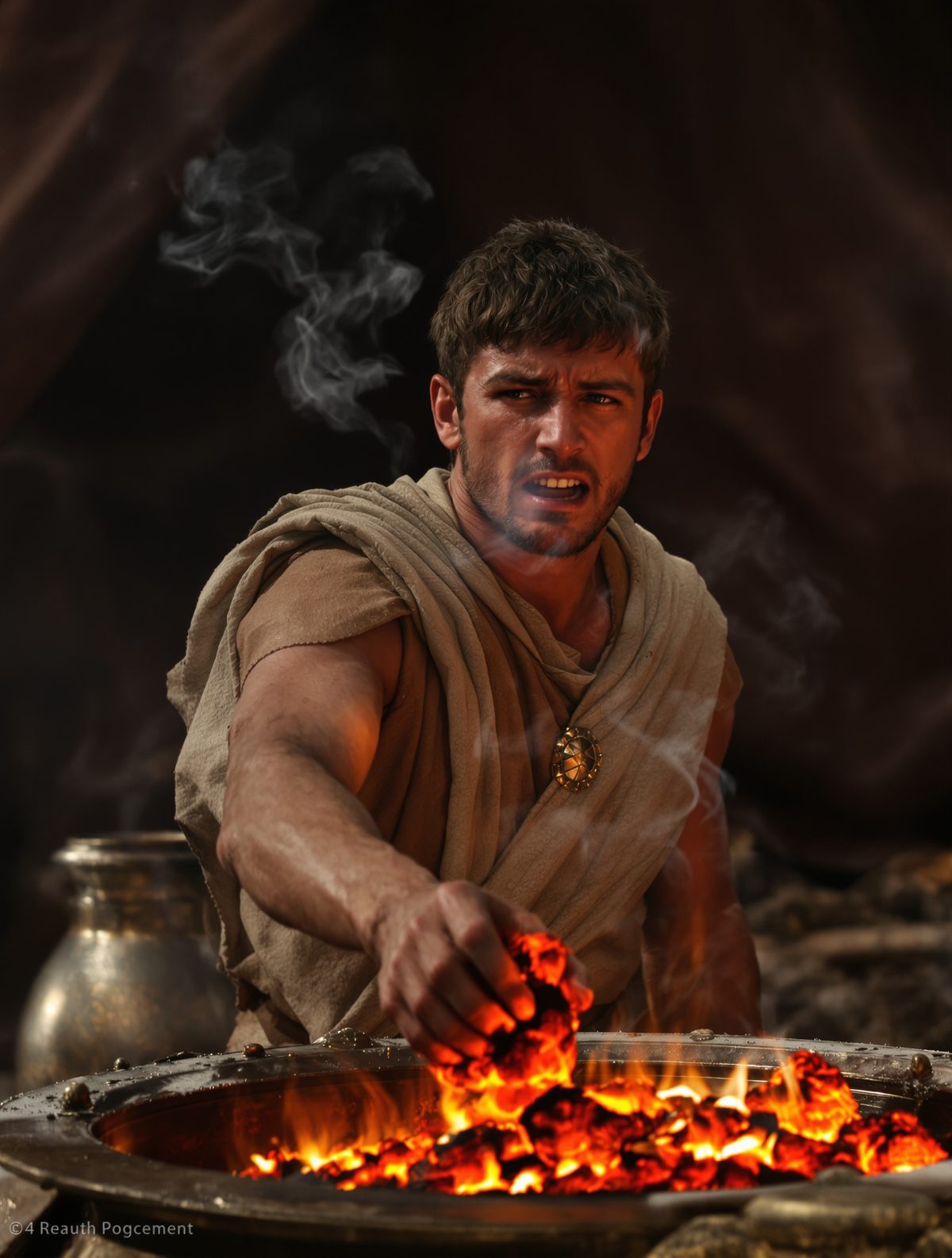
The morning sun blazed over the marble columns of the Athenian agora in 430 BC, but for one man standing trial, its golden rays held no divine promise—only the cold reality of exile. Anaxagoras of Clazomenae, the brilliant philosopher who had once walked these same stones teaching the city's elite, now faced a charge that could cost him everything: impiety against the gods.
His crime? Declaring that the sun—revered by every Athenian as the mighty god Helios—was nothing more than a massive, glowing rock. Not just any rock, mind you, but one larger than the entire Peloponnese peninsula. To the horrified citizens of Athens, this wasn't just heresy; it was an assault on the very foundations of their world.
The Radical Who Dared to Question Everything
Anaxagoras had arrived in Athens around 480 BC, a brilliant mind from the Ionian coast of Asia Minor where Greek philosophy had first bloomed. Unlike the mythological explanations that satisfied most Greeks, he sought natural causes for everything he observed. While his contemporaries saw divine intervention in every rainbow and earthquake, Anaxagoras saw patterns, mechanisms, and natural forces at work.
His revolutionary ideas extended far beyond the sun. He proposed that the moon's light was merely reflected sunlight—a concept so radical it made people's heads spin. Even more shocking, he suggested that the moon had mountains and valleys just like Earth, and that its phases resulted from the shadow cast by our own planet. When a massive meteorite crashed near the Aegospotami River in 467 BC, most Athenians trembled at what they assumed was divine wrath. Anaxagoras calmly declared it proof of his theory: celestial bodies were indeed chunks of stone and metal, not gods.
But perhaps his most audacious claim was about nous—mind or intelligence—as the organizing principle of the universe. While this might sound mystical, Anaxagoras meant something startlingly modern: that natural laws, not capricious gods, governed the cosmos. Everything that happened had a rational explanation waiting to be discovered.
The Teacher of Giants
For nearly three decades, Athens embraced this dangerous thinker. His ideas captivated the city's intellectual elite, including some of history's most influential figures. Pericles, the golden-tongued statesman who would give his name to Athens' greatest age, sat at Anaxagoras's feet absorbing lessons about the natural world. The playwright Euripides, whose tragedies would echo through the centuries, found inspiration in the philosopher's rational approach to human nature.
Anaxagoras's influence on Pericles was particularly profound. The statesman's famous composure during a solar eclipse—while terrified sailors cowered—came directly from his teacher's lessons about celestial mechanics. When Pericles calmly explained to his crew that an eclipse was simply the moon passing between Earth and sun, he was channeling pure Anaxagorean wisdom.
The philosopher's teaching methods were as revolutionary as his ideas. Rather than simply lecturing, he encouraged students to observe, question, and think for themselves. He dissected animals to understand anatomy, studied the behavior of magnets, and even conducted primitive experiments with air pressure. In an age when most learning consisted of memorizing epic poetry, Anaxagoras was teaching something unprecedented: the scientific method.
When Athens Turned Against Reason
But by 430 BC, the political winds had shifted dramatically. Athens was locked in a devastating war with Sparta, the plague was ravaging the city, and people were desperate for someone to blame. Pericles, once beloved, now faced fierce opposition from conservatives who saw his rationalist approach as dangerously impious. What better way to attack the great statesman than to target his most controversial teacher?
The charges against Anaxagoras were brought by Cleon, a demagogue who understood that fear and superstition could be powerful political weapons. The formal accusation was asebeia—impiety—a catch-all charge that had become the weapon of choice against intellectuals and freethinkers. Socrates would face the same accusation thirty years later.
The specific allegations were damning in their simplicity: Anaxagoras taught that the sun was a stone and the moon was earth. To modern ears, this sounds like basic astronomy. To 5th-century Athenians, it was blasphemy of the highest order. How could their crops grow, their sailors navigate, or their warriors find courage if the sun-god Helios was nothing but a burning rock?
The trial itself was a spectacle that revealed the deep tensions between reason and tradition, between the old Athens of myth and the new Athens of inquiry. Witnesses testified about Anaxagoras's shocking teachings, his dissection of animals (surely proof of impiety), and his influence on the increasingly unpopular Pericles.
The Price of Truth
Faced with almost certain conviction and the death penalty, Anaxagoras made a choice that would echo through history. Rather than recant his beliefs or face execution, he chose exile. Pericles, using all his political influence, managed to secure this alternative punishment, but the cost was enormous. Anaxagoras would be forever banished from the city that had been his home for thirty years.
The philosopher's response to his sentence revealed his character. When told he would never see Athens again, he reportedly said, "It is not I who have lost Athens, but Athens who has lost me." When someone lamented that he would die in a foreign land, he replied with characteristic wit: "The descent to Hades is the same from every place."
Anaxagoras spent his final years in Lampsacus on the Hellespont, where he was welcomed as a honored teacher. The city's gratitude was so great that they declared a public holiday on the anniversary of his death, a tradition that continued for centuries. Even in exile, he continued teaching and writing, never abandoning the rational inquiry that had cost him everything.
The Dangerous Legacy of a Stone Sun
The banishment of Anaxagoras marked a turning point in Athens's relationship with intellectual freedom. The city that prided itself on democracy and culture had chosen superstition over science, fear over knowledge. It was a decision that would have profound consequences: within a generation, Athens would execute Socrates for similar "crimes" against traditional belief.
Yet Anaxagoras's ideas proved unstoppable. His student Archelaus taught Socrates, creating a direct line of influence from the exiled philosopher to the father of Western philosophy. His theories about the sun, moon, and planets laid groundwork for later astronomers like Aristarchus and eventually Copernicus. His concept of nous as an organizing principle influenced everyone from Aristotle to medieval Islamic philosophers.
Perhaps most importantly, Anaxagoras established a principle that would define science itself: the courage to follow evidence wherever it leads, regardless of how uncomfortable the destination might be. When he declared the sun was stone, he wasn't just making an astronomical observation—he was asserting humanity's right to understand the universe through reason rather than revelation.
Why Ancient Athens Still Matters Today
The trial of Anaxagoras feels startlingly contemporary in an age when scientific conclusions about climate change, evolution, and public health face fierce resistance from those who prefer comfortable myths to inconvenient truths. The philosopher who was banished for saying the sun was stone reminds us that the battle between evidence and ideology, between curiosity and certainty, is as old as civilization itself.
Every time a researcher publishes findings that challenge popular beliefs, every time a teacher explains evolution to skeptical students, every time someone chooses facts over feelings, they're walking in the footsteps of that brave man who looked up at the sun 2,400 years ago and saw not a god, but a giant, glowing stone. His exile was Athens's loss—and humanity's gain.